
在遗传风险最高的一成人群中筛查,找到了常规路径可能漏掉的中高风险前列腺癌
The New England Journal of Medicine2025诊断准确性研究Crossref 记录被引 127 次
谁会被常规检查挡在活检门外?
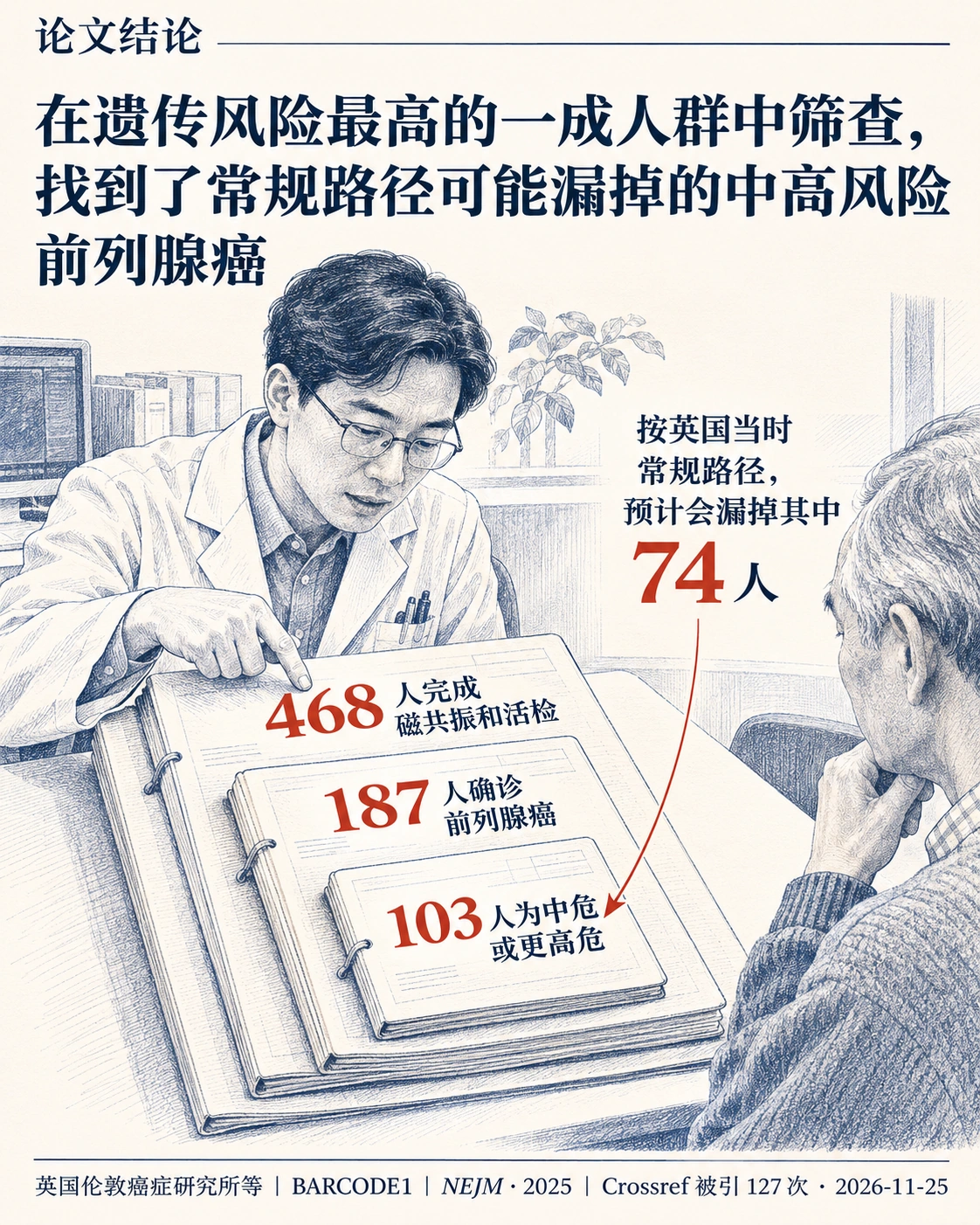
英国研究按遗传风险挑出一组男性,邀请他们接受磁共振和活检。在完成检查的 468 人中,103 人查出中危或更高危前列腺癌。期刊终版估算,其中 74 人按英国当时的常规路径可能查不出来。
推荐阅读的理由
一个人即使血液 PSA 不高,或磁共振没有可疑征象,仍可能有值得治疗的癌。BARCODE1 先用唾液中的遗传标记挑出高风险人群,再邀请他们检查,无论 PSA 高低都做磁共振和活检。这才让作者能倒回去问:如果把同一批人按常规条件筛一遍,会漏掉谁?
Assessment of a Polygenic Risk Score in Screening for Prostate Cancer
作者接受稿摘要 · 中文编译
背景 前列腺癌发病率在上升。以血液前列腺特异抗原(PSA)筛查,假阳性率较高。全基因组关联研究已识别出与前列腺癌有关的常见遗传变异,可将其合成多基因风险评分。
方法 BARCODE1 通过英国基层医疗机构招募 55 至 69 岁参与者,用唾液提取的生殖系 DNA 中 130 个风险标记算出评分。评分高于第 90 百分位者,无论 PSA 如何,都获邀接受多参数磁共振和经会阴前列腺活检。
结果 40,292 名受邀者当中,8,953 人(22.2%)表示有兴趣,6,393 人取得评分,745 人(11.7%)进入高分组。其中 468 人完成两项检查,187 人(40.0%)确诊,中位确诊年龄 64 岁(范围 57 至 73)。按接受稿采用的 2023 年 NCCN 标准,103 人(55.1%)属于需治疗的中危或高危;按当时英国诊断路径,预计其中 73 人(70.9%)不会被发现。187 人中有 40 人(21.4%)属不利中危、高危或极高危。
结论 按多基因评分为 6,393 人分层,发现 103 人的前列腺癌需要临床处理,其中 73 人按英国标准诊断路径预计会被漏过。研究获欧洲研究理事会第七框架计划等资助,登记号 NCT03857477。
展开英文原摘要收起英文原摘要The incidence of prostate cancer (PrCa) is increasing. Screening by assay of prostate-specific antigen (PSA) has a high false-positive rate. Genome wide association studies have identified common germline variants, which can be used to calculate a polygenic risk score (PRS) associated with PrCa risk. The BARCODE1 study recruited persons aged 55 to 69 yrs via primary care in the UK. PRS were derived from 130 PrCa risk variants in germline DNA extracted from saliva. Participants with a PRS >90th centile were invited for PrCa screening using multiparametric Magnetic Resonance Imaging (MRI) and transperineal biopsy, irrespective of PSA result. Of 40,292 persons invited to participate, 8,953 (22.2%) expressed interest in participating and 6,393 had their PRS calculated, of whom 745 (11.7%) had a PRS >90th centile and were invited for screening. Of these 745 participants, 468 underwent MRI and prostate biopsy; PrCa was detected in 187 (40.0%) of them. Median age at diagnosis was 64 yrs (range 57 to 73 yrs). Using NCCN criteria (2023), 103 (55.1%) cancers were of intermediate or high risk and so required treatment; 73 (70.9%) of these cancers would not have been detected using the UK PrCa diagnostic pathway. Of the 187 cancers, 40 (21.4%) were ‘Intermediate Unfavorable’/’High’/’Very High-Risk’. Risk stratification by PRS of 6,393 persons led to the detection of PrCa requiring clinical management in 103 participants, of whom 73 (70.9%) would have been missed using the standard diagnostic pathway used in the UK. (Funded by European Research Council Seventh Framework Programme, and others. ClinicalTrials.gov, NCT03857477)
Background · The incidence of prostate cancer (PrCa) is increasing. Screening by assay of prostate-specific antigen (PSA) has a high false-positive rate. Genome wide association studies have identified common germline variants, which can be used to calculate a polygenic risk score (PRS) associated with PrCa risk.
Methods · The BARCODE1 study recruited persons aged 55 to 69 yrs via primary care in the UK. PRS were derived from 130 PrCa risk variants in germline DNA extracted from saliva. Participants with a PRS >90th centile were invited for PrCa screening using multiparametric Magnetic Resonance Imaging (MRI) and transperineal biopsy, irrespective of PSA result.
Results · Of 40,292 persons invited to participate, 8,953 (22.2%) expressed interest in participating and 6,393 had their PRS calculated, of whom 745 (11.7%) had a PRS >90th centile and were invited for screening. Of these 745 participants, 468 underwent MRI and prostate biopsy; PrCa was detected in 187 (40.0%) of them. Median age at diagnosis was 64 yrs (range 57 to 73 yrs). Using NCCN criteria (2023), 103 (55.1%) cancers were of intermediate or high risk and so required treatment; 73 (70.9%) of these cancers would not have been detected using the UK PrCa diagnostic pathway. Of the 187 cancers, 40 (21.4%) were ‘Intermediate Unfavorable’/’High’/’Very High-Risk’.
Conclusions · Risk stratification by PRS of 6,393 persons led to the detection of PrCa requiring clinical management in 103 participants, of whom 73 (70.9%) would have been missed using the standard diagnostic pathway used in the UK. (Funded by European Research Council Seventh Framework Programme, and others. ClinicalTrials.gov, NCT03857477)
Jana K McHugh, Elizabeth K Bancroft, Edward Saunders, Mark N Brook, Eva McGrowder, Sarah Wakerell, Denzil James, Reshma Rageevakumar, Barbara Benton, Natalie Taylor, Kathryn Myhill, Matthew Hogben, Netty Kinsella, Aslam A Sohaib, Declan Cahill, Stephen Hazell, Samuel J Withey, Naami Mcaddy, Elizabeth C Page, Andrea Osborne, Sarah Benafif, Ann-Britt Jones, Dhruv Patel, Dean Y Huang, Kaljit Kaur, Bradley Russell, Ray Nicholson, Fionnuala Croft, Justyna Sobczak, Claire McNally, Fiona Mutch, Samantha Bennett, Lenita Kingston, Questa Karlsson, Tokhir Dadaev, Sibel Saya, Susan Merson, Angela Wood, Nening Dennis, Nafisa Hussain, Alison Thwaites, Syed Hussain, Imran Rafi, Michelle Ferris, Pardeep Kumar, Nicholas D James, Nora Pashayan, Zsofia Kote-Jarai, Rosalind A Eeles, BARCODE1 Steering Committee and Collaborators
从评估遗传风险到确诊,分母怎样变化?
| 到达哪一步 | 人数 |
|---|---|
| 获邀请参加研究/表示有兴趣 | 40,292/8,953 |
| 算出遗传风险/达到高分组 | 6,393/745 |
| 完成磁共振和活检/查出癌症 | 468/187 |
| 中危或更高危/按当时常规路径预计漏掉(期刊终版) | 103/74 |
中危或更高危的比例为全部确诊者的 103/187。终版采用 2024 年 NCCN 分类。 核对作者图表
作者的结论
作者认为,在遗传风险评分位居前一成的参与者中,这种筛查发现了更多临床上有意义的癌。研究报告的是首次筛查的检出结果。推广后能否减少晚期病例或死亡,还需随访和比较。
研究团队与论文影响
英国伦敦癌症研究所等开展的前瞻性单组 BARCODE1 研究,从基层医疗机构招募参与者。论文由《新英格兰医学杂志》发表,预注册编号 NCT03857477。
Crossref 收录本文引用 127 次。
单篇与期刊指标核查于 。
原文与延伸阅读
引用这篇文章与反馈纠错
研象编辑部.在遗传风险最高的一成人群中筛查,找到了常规路径可能漏掉的中高风险前列腺癌[EB/OL].研象,2026-11-25.https://yanxiang.hk/papers/barcode1-prostate-polygenic-screening
发现数字、译文或出处有误,可以在邮件里指出相应段落,附上核对依据。