
出生后前三年居住地空气污染较重的儿童,后来更常被诊断为哮喘
JAMA Network Open2024队列研究Crossref 记录被引 97 次
门牌号怎样变成可以与儿童病史对照的数据?
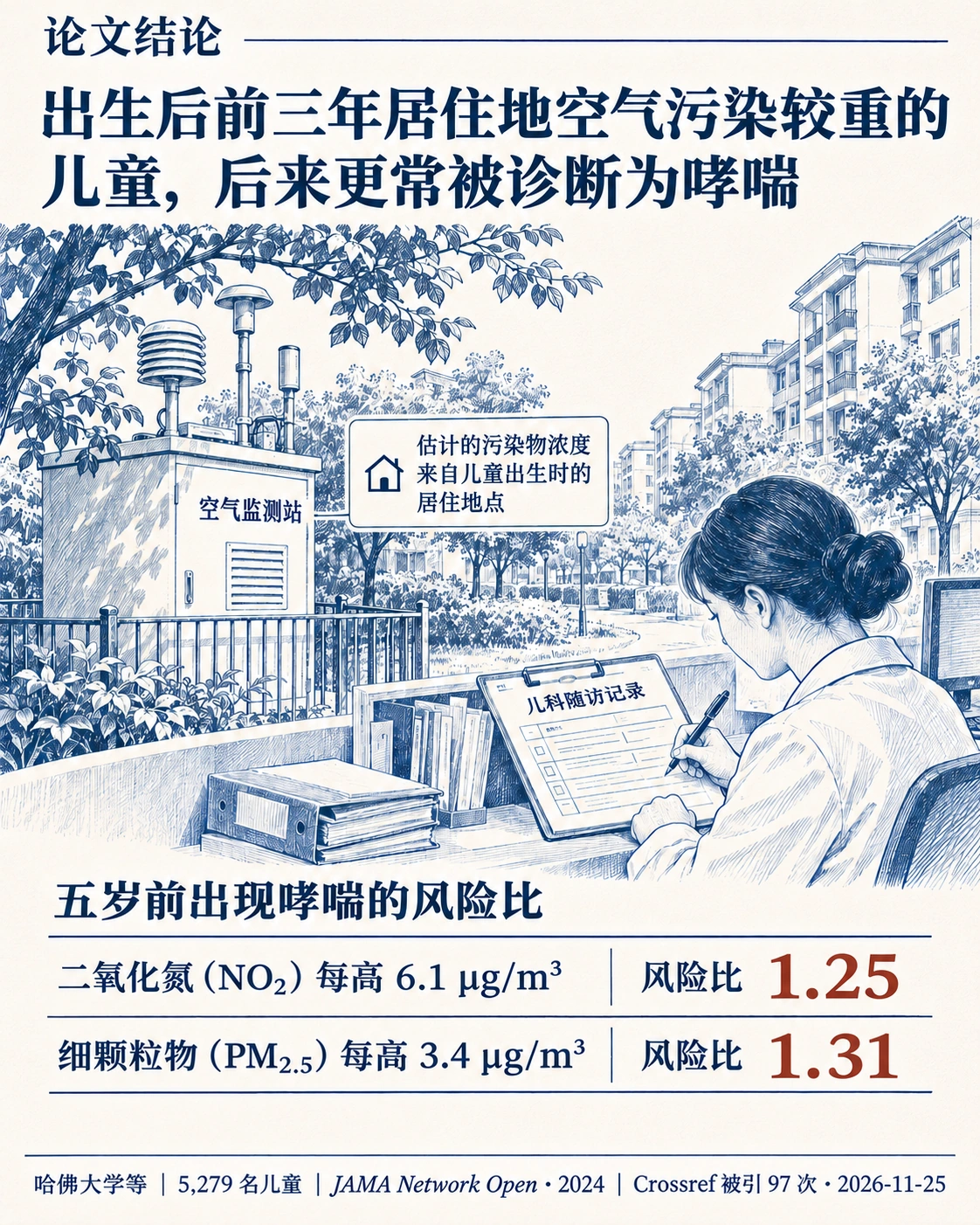
美国出生队列中,出生住址前三年的二氧化氮或细颗粒物浓度越高,孩子后来获诊哮喘的风险越高。生活资源较少的社区中,这种关联往往更强。
推荐阅读的理由
研究者用孩子出生时的住址估计当地空气污染,把前三年的平均浓度同多年随访中的哮喘诊断对照。两种污染物各有自己的计量增幅;图里的 1.25 和 1.31,不能直接用来判断哪种污染物每一微克更危险。
Early-Life Exposure to Air Pollution and Childhood Asthma Cumulative Incidence in the ECHO CREW Consortium
作者摘要 · 中文编译
背景与目的 室外空气污染与儿童哮喘有关,但以往许多研究覆盖的地理、族群和社会经济背景不够广,很难判断谁更易受影响。作者研究生命早期细颗粒物和二氧化氮暴露与幼儿期、儿童中期哮喘的关系,并评估个人及社区特征是否改变这一关系。
设计 研究纳入美国儿童呼吸与环境工作组联盟的多个出生队列。1987 至 2007 年招募,随访最长至 11 岁。以出生住址估计污染物暴露,由照护者报告孩子是否在幼儿期(4 岁)及儿童中期(11 岁)被医生诊断为哮喘。生存分析校正母亲受教育程度、父母哮喘、孕期吸烟、儿童种族族裔与性别、社区特征和队列。2022 年 2 月至 2023 年 12 月进行分析。
结果 共 5,279 名儿童,黑人 1,659 人(31.4%),西班牙裔 835 人(15.8%),白人 2,555 人(48.4%),其他族群 229 人(4.3%)。原摘要列男孩 2,721 人、女孩 2,596 人;该处两数相加与总人数不一致。到 4 岁有 954 人(18.1%)获诊哮喘,到 11 岁有 1,305 人(24.7%)。出生后三年平均二氧化氮每高 6.1 µg/m³,幼儿期和儿童中期的风险比分别为 1.25(95% 置信区间 1.03 至 1.52)和 1.22(1.04 至 1.44);细颗粒物每高 3.4 µg/m³,相应估计为 1.31(1.04 至 1.66)和 1.23(1.01 至 1.50)。母亲未高中毕业的儿童、黑人儿童、儿童发展机会较少的社区,以及黑人人口占比或人口密度较高的社区,往往呈现更强的关联。例如,细颗粒物与 5 岁前哮喘的风险比,黑人儿童为 1.60(1.15 至 2.22),白人儿童为 1.17(0.90 至 1.52)。
结论 生命早期空气污染与儿童哮喘发生增加有关。生活在发展机会和资源较少、同时面对多种环境暴露的城市社区的少数族群家庭风险更高。作者认为,降低美国儿童哮喘风险需要在减少空气污染的同时改善社区层面的环境、教育和健康公平。
展开英文原摘要收起英文原摘要Exposure to outdoor air pollution contributes to childhood asthma development, but many studies lack the geographic, racial and ethnic, and socioeconomic diversity to evaluate susceptibility by individual-level and community-level contextual factors. To examine early life exposure to fine particulate matter (PM2.5) and nitrogen oxide (NO2) air pollution and asthma risk by early and middle childhood, and whether individual and community-level characteristics modify associations between air pollution exposure and asthma. This cohort study included children enrolled in cohorts participating in the Children’s Respiratory and Environmental Workgroup consortium. The birth cohorts were located throughout the US, recruited between 1987 and 2007, and followed up through age 11 years. The survival analysis was adjusted for mother’s education, parental asthma, smoking during pregnancy, child’s race and ethnicity, sex, neighborhood characteristics, and cohort. Statistical analysis was performed from February 2022 to December 2023. Early-life exposures to PM2.5 and NO2 according to participants’ birth address. Caregiver report of physician-diagnosed asthma through early (age 4 years) and middle (age 11 years) childhood. Among 5279 children included, 1659 (31.4%) were Black, 835 (15.8%) were Hispanic, 2555 (48.4%) where White, and 229 (4.3%) were other race or ethnicity; 2721 (51.5%) were male and 2596 (49.2%) were female; 1305 children (24.7%) had asthma by 11 years of age and 954 (18.1%) had asthma by 4 years of age. Mean values of pollutants over the first 3 years of life were associated with asthma incidence. A 1 IQR increase in NO2 (6.1 μg/m3) was associated with increased asthma incidence among children younger than 5 years (HR, 1.25 [95% CI, 1.03-1.52]) and children younger than 11 years (HR, 1.22 [95% CI, 1.04-1.44]). A 1 IQR increase in PM2.5 (3.4 μg/m3) was associated with increased asthma incidence among children younger than 5 years (HR, 1.31 [95% CI, 1.04-1.66]) and children younger than 11 years (OR, 1.23 [95% CI, 1.01-1.50]). Associations of PM2.5 or NO2 with asthma were increased when mothers had less than a high school diploma, among Black children, in communities with fewer child opportunities, and in census tracts with higher percentage Black population and population density; for example, there was a significantly higher association between PM2.5 and asthma incidence by younger than 5 years of age in Black children (HR, 1.60 [95% CI, 1.15-2.22]) compared with White children (HR, 1.17 [95% CI, 0.90-1.52]). In this cohort study, early life air pollution was associated with increased asthma incidence by early and middle childhood, with higher risk among minoritized families living in urban communities characterized by fewer opportunities and resources and multiple environmental coexposures. Reducing asthma risk in the US requires air pollution regulation and reduction combined with greater environmental, educational, and health equity at the community level.
Importance · Exposure to outdoor air pollution contributes to childhood asthma development, but many studies lack the geographic, racial and ethnic, and socioeconomic diversity to evaluate susceptibility by individual-level and community-level contextual factors.
Objective · To examine early life exposure to fine particulate matter (PM2.5) and nitrogen oxide (NO2) air pollution and asthma risk by early and middle childhood, and whether individual and community-level characteristics modify associations between air pollution exposure and asthma.
Design, Setting, and Participants · This cohort study included children enrolled in cohorts participating in the Children’s Respiratory and Environmental Workgroup consortium. The birth cohorts were located throughout the US, recruited between 1987 and 2007, and followed up through age 11 years. The survival analysis was adjusted for mother’s education, parental asthma, smoking during pregnancy, child’s race and ethnicity, sex, neighborhood characteristics, and cohort. Statistical analysis was performed from February 2022 to December 2023.
Exposure · Early-life exposures to PM2.5 and NO2 according to participants’ birth address.
Main Outcomes and Measures · Caregiver report of physician-diagnosed asthma through early (age 4 years) and middle (age 11 years) childhood.
Results · Among 5279 children included, 1659 (31.4%) were Black, 835 (15.8%) were Hispanic, 2555 (48.4%) where White, and 229 (4.3%) were other race or ethnicity; 2721 (51.5%) were male and 2596 (49.2%) were female; 1305 children (24.7%) had asthma by 11 years of age and 954 (18.1%) had asthma by 4 years of age. Mean values of pollutants over the first 3 years of life were associated with asthma incidence. A 1 IQR increase in NO2 (6.1 μg/m3) was associated with increased asthma incidence among children younger than 5 years (HR, 1.25 [95% CI, 1.03-1.52]) and children younger than 11 years (HR, 1.22 [95% CI, 1.04-1.44]). A 1 IQR increase in PM2.5 (3.4 μg/m3) was associated with increased asthma incidence among children younger than 5 years (HR, 1.31 [95% CI, 1.04-1.66]) and children younger than 11 years (OR, 1.23 [95% CI, 1.01-1.50]). Associations of PM2.5 or NO2 with asthma were increased when mothers had less than a high school diploma, among Black children, in communities with fewer child opportunities, and in census tracts with higher percentage Black population and population density; for example, there was a significantly higher association between PM2.5 and asthma incidence by younger than 5 years of age in Black children (HR, 1.60 [95% CI, 1.15-2.22]) compared with White children (HR, 1.17 [95% CI, 0.90-1.52]).
Conclusions and Relevance · In this cohort study, early life air pollution was associated with increased asthma incidence by early and middle childhood, with higher risk among minoritized families living in urban communities characterized by fewer opportunities and resources and multiple environmental coexposures. Reducing asthma risk in the US requires air pollution regulation and reduction combined with greater environmental, educational, and health equity at the community level.
Antonella Zanobetti, Patrick H Ryan, Brent A Coull, Heike Luttmann-Gibson, Soma Datta, Jeffrey Blossom, Cole Brokamp, Nathan Lothrop, Rachel L Miller, Paloma I Beamer, Cynthia M Visness, Howard Andrews, Leonard B Bacharier, Tina Hartert, Christine C Johnson, Dennis R Ownby, Gurjit K Khurana Hershey, Christine L M Joseph, Eneida A Mendonça, Daniel J Jackson, Edward M Zoratti, Anne L Wright, Fernando D Martinez, Christine M Seroogy, Sima K Ramratnam, Agustin Calatroni, James E Gern, Diane R Gold, ECHO Children’s Respiratory and Environmental Workgroup
Copyright 2024 Zanobetti A et al. JAMA Network Open.
出生住址前三年平均污染浓度每高一个四分位间距
| 污染物(增幅) | 4 岁结局的风险比 | 11 岁结局的风险比 |
|---|---|---|
| 二氧化氮(6.1 µg/m³) | 1.25(1.03 至 1.52) | 1.22(1.04 至 1.44) |
| 细颗粒物(3.4 µg/m³) | 1.31(1.04 至 1.66) | 1.23(1.01 至 1.50) |
括号内为 95% 置信区间。据表 2 的生存分析;英文摘要把第二行 11 岁结果标为 OR,原表将这组数值列作 HR。 核对作者图表
作者的结论
作者认为,生命早期室外空气污染与儿童早期和中期发生哮喘有关,资源和机会较少、同时承受多种环境暴露的城市社区尤其值得关注。他们主张同时减少污染和改善社区环境、教育与医疗条件。
研究团队与论文影响
哈佛大学陈曾熙公共卫生学院等团队联合美国多个出生队列,以个人出生住址估算污染暴露。研究同时考虑父母哮喘史、孕期吸烟和社区特征,并随访至儿童期。
Crossref 收录本文引用 97 次。JAMA Network Open 在 2025 年度回顾中列出的期刊影响因子为 9.7。
单篇与期刊指标核查于 。
原文与延伸阅读
引用这篇文章与反馈纠错
研象编辑部.出生后前三年居住地空气污染较重的儿童,后来更常被诊断为哮喘[EB/OL].研象,2026-11-25.https://yanxiang.hk/papers/birth-address-childhood-asthma
发现数字、译文或出处有误,可以在邮件里指出相应段落,附上核对依据。