
与足月出生者相比,早产者的死亡风险差在婴儿期最大,成年后仍能观察到
JAMA Network Open2024人群登记研究Crossref 记录被引 56 次
“风险高很多”到了不同年龄,实际相差多少?
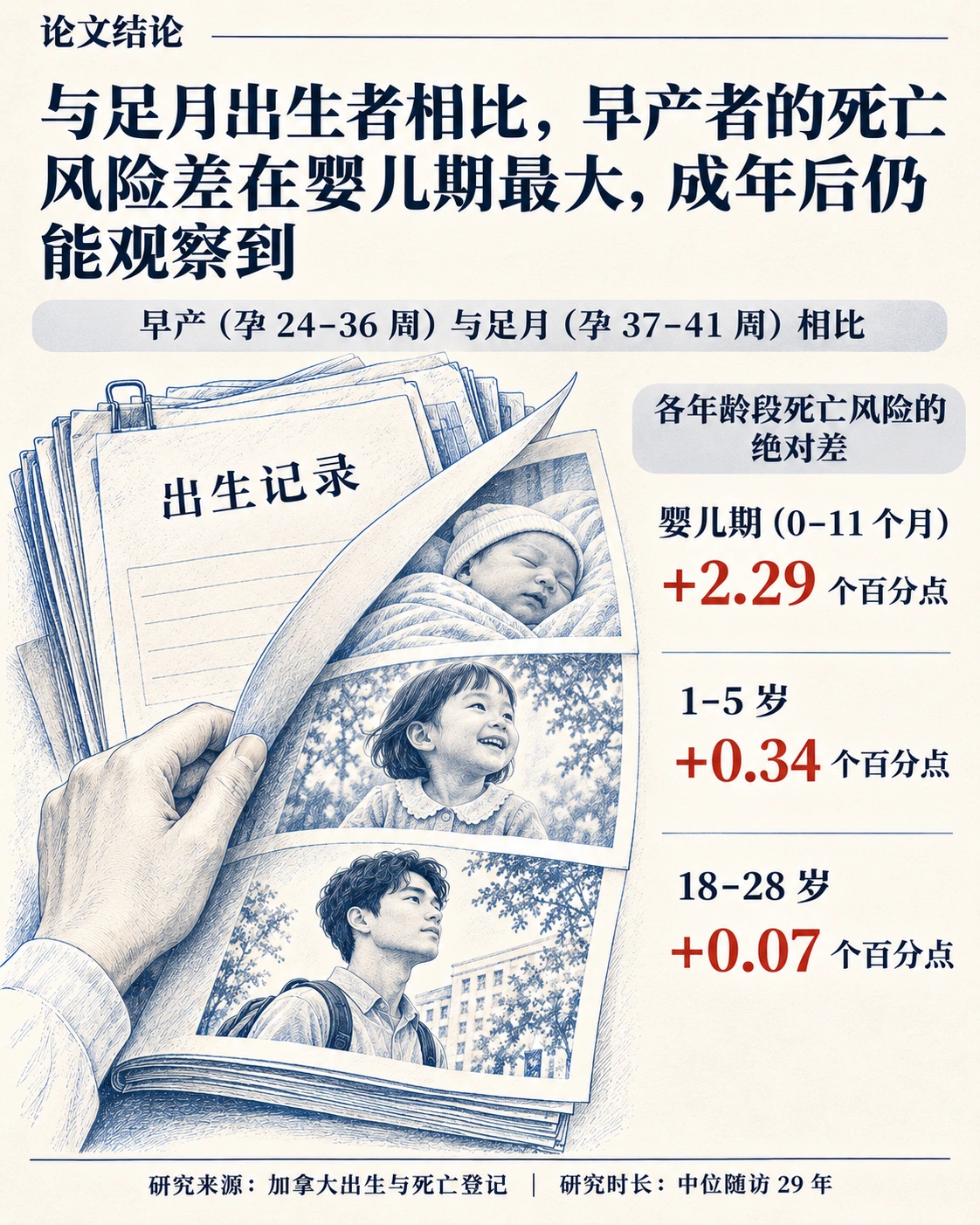
加拿大近 500 万名出生者的登记记录显示,与足月出生者相比,早产者死亡风险的绝对差在婴儿期最大。到了 18 至 28 岁,差距缩小到 0.07 个百分点,仍可观察到。
推荐阅读的理由
在出生后头一年,两组的死亡风险相差 2.29 个百分点,换算成每一万名约相差 229 人。到 18 至 28 岁这一年龄段,相差约每万人 7 人。研究是沿生命阶段分别比较早产与足月出生者,因此不能把各段的数值相加当作一个人的终身风险。
Short-Term and Long-Term Mortality Risk After Preterm Birth
作者摘要 · 中文编译
背景与目的 早产是新生儿死亡的重要原因,但新生儿期之后的死亡情况,尤其北美的长期证据,比较有限。研究考察早产与从出生到 23 至 36 岁之间全部死因及特定死因死亡的关联。
方法 在加拿大出生的人群中匹配队列,纳入 1983 年 1 月 1 日至 1996 年 12 月 31 日活产者,随访至 2019 年 12 月 31 日。早产按孕 24 至 27、28 至 31、32 至 33、34 至 36 周分组,与 37 至 41 周足月出生者比较。按 0 至 11 个月及 1 至 5、6 至 12、13 至 17、18 至 28、29 至 36 岁的预设阶段,用对数二项模型估计全因死亡风险差与风险比,用 Cox 模型估计特定死因的风险比(其他死因死亡者作删失处理)。研究按基线特征进行粗化精确匹配,2023 年 6 月至 2024 年 4 月分析。
结果 4,998,560 名出生者中男性占 54.2%,6.9% 早产,其中孕 24 至 27、28 至 31、32 至 33、34 至 36 周出生者分别占 0.3%、0.6%、0.8%、5.1%。中位随访 29 年,共有 72,662 人死亡(早产者 14,312、足月者 58,350)。各年龄段早产者的死亡风险均较高。差距在婴儿期和幼儿期最大:头 11 个月风险差 2.29 个百分点(95% 置信区间 2.23 至 2.35),风险比 11.61(11.09 至 12.15);1 至 5 岁分别为 0.34 个百分点(0.31 至 0.36)和 2.79(2.61 至 2.98)。18 至 28 岁差距最小,分别为 0.07 个百分点(0.04 至 0.10)和 1.13(1.07 至 1.19)。呼吸、循环、消化、神经、内分泌、感染性疾病、癌症、先天畸形及围产期疾病等死因的风险升高,未见与外部死因的关联。出生孕周较大者的风险往往较低。
结论 早产与从出生到生命第三、第四个十年期间较高死亡风险有关,出生孕周越小风险越高。部分关联可能源于同时影响早产和死亡的健康决定因素。早产可作为死亡风险因素,为预防策略提供信息。
展开英文原摘要收起英文原摘要Preterm birth (PTB) is a leading cause of neonatal mortality. However, evidence on mortality beyond the neonatal period is limited, especially in North America. To examine associations of PTB with all-cause and cause-specific mortality from birth through 23 to 36 years of age. This population-based matched cohort study of live births in Canada included individuals born between January 1, 1983, and December 31, 1996, and followed up until December 31, 2019. Data were analyzed from June 1, 2023, to April 30, 2024. PTBs, between 24 and 37 weeks’ gestation (with gestational age [GA]-specific subcategories of 24 to 27 weeks, 28 to 31 weeks, 32 to 33 weeks, and 34 to 36 weeks) compared with term births (37-41 weeks’ gestation). All-cause mortality and cause-specific mortality were the main outcomes. Risk differences (RDs) and risk ratios (RRs) were estimated for all-cause mortality using log-binomial regressions and hazard ratios were estimated for cause-specific mortality using Cox proportional hazards regression models (censoring individuals who died from other causes) within prespecified age intervals (ages 0-11 months and ages 1-5, 6-12, 13-17, 18-28, and 29-36 years). Observed confounding was accounted for using coarsened exact matching on baseline characteristics. Of 4 998 560 births (54.2% male), 6.9% were born preterm (with GA-specific subcategories of 0.3% born at 24-27 weeks, 0.6% at 28-31 weeks, 0.8% at 32-33 weeks, and 5.1% at 34-36 weeks). During a median of 29 years of follow-up, 72 662 individuals died (14 312 born preterm and 58 350 at term). PTB was associated with an increased risk of death in all age intervals, with the highest RDs and RRs from birth through infancy (ages 0-11 months) (RD, 2.29% [95% CI, 2.23%-2.35%]; RR, 11.61 [95% CI, 11.09-12.15]) and in early childhood (ages 1-5 years) (RD, 0.34% [95% CI, 0.31%-0.36%]; RR, 2.79 [95% CI, 2.61-2.98]) and the lowest RDs and RRs among those between ages 18 and 28 years (RD, 0.07% [95% CI, 0.04%-0.10%]; RR, 1.13 [95% CI, 1.07-1.19]). We identified increased risks of mortality associated with several causes, including respiratory, circulatory, and digestive system disorders; nervous system, endocrine, and infectious diseases; cancers; congenital malformations; and conditions originating in the perinatal period. No associations were found for external causes of deaths. Associations by GA categories suggested lower risks with higher GA. The findings of this population-based matched cohort study suggest that individuals born preterm were at an increased risk of death from birth until their third and fourth decades of life, with higher risks as GA decreased. Some of these associations may have been partly due to underlying health determinants that affected PTB and mortality. These findings suggest that PTB should be recognized as a risk factor for mortality and could inform preventive strategies.
Importance · Preterm birth (PTB) is a leading cause of neonatal mortality. However, evidence on mortality beyond the neonatal period is limited, especially in North America.
Objective · To examine associations of PTB with all-cause and cause-specific mortality from birth through 23 to 36 years of age.
Design, Setting, and Participants · This population-based matched cohort study of live births in Canada included individuals born between January 1, 1983, and December 31, 1996, and followed up until December 31, 2019. Data were analyzed from June 1, 2023, to April 30, 2024.
Exposure · PTBs, between 24 and 37 weeks’ gestation (with gestational age [GA]-specific subcategories of 24 to 27 weeks, 28 to 31 weeks, 32 to 33 weeks, and 34 to 36 weeks) compared with term births (37-41 weeks’ gestation).
Main Outcomes and Measures · All-cause mortality and cause-specific mortality were the main outcomes. Risk differences (RDs) and risk ratios (RRs) were estimated for all-cause mortality using log-binomial regressions and hazard ratios were estimated for cause-specific mortality using Cox proportional hazards regression models (censoring individuals who died from other causes) within prespecified age intervals (ages 0-11 months and ages 1-5, 6-12, 13-17, 18-28, and 29-36 years). Observed confounding was accounted for using coarsened exact matching on baseline characteristics.
Results · Of 4 998 560 births (54.2% male), 6.9% were born preterm (with GA-specific subcategories of 0.3% born at 24-27 weeks, 0.6% at 28-31 weeks, 0.8% at 32-33 weeks, and 5.1% at 34-36 weeks). During a median of 29 years of follow-up, 72 662 individuals died (14 312 born preterm and 58 350 at term). PTB was associated with an increased risk of death in all age intervals, with the highest RDs and RRs from birth through infancy (ages 0-11 months) (RD, 2.29% [95% CI, 2.23%-2.35%]; RR, 11.61 [95% CI, 11.09-12.15]) and in early childhood (ages 1-5 years) (RD, 0.34% [95% CI, 0.31%-0.36%]; RR, 2.79 [95% CI, 2.61-2.98]) and the lowest RDs and RRs among those between ages 18 and 28 years (RD, 0.07% [95% CI, 0.04%-0.10%]; RR, 1.13 [95% CI, 1.07-1.19]). We identified increased risks of mortality associated with several causes, including respiratory, circulatory, and digestive system disorders; nervous system, endocrine, and infectious diseases; cancers; congenital malformations; and conditions originating in the perinatal period. No associations were found for external causes of deaths. Associations by GA categories suggested lower risks with higher GA.
Conclusions and Relevance · The findings of this population-based matched cohort study suggest that individuals born preterm were at an increased risk of death from birth until their third and fourth decades of life, with higher risks as GA decreased. Some of these associations may have been partly due to underlying health determinants that affected PTB and mortality. These findings suggest that PTB should be recognized as a risk factor for mortality and could inform preventive strategies.
Asma M Ahmed, Sonia M Grandi, Eleanor Pullenayegum, Sarah D McDonald, Marc Beltempo, Shahirose S Premji, Jason D Pole, Fabiana Bacchini, Prakesh S Shah, Petros Pechlivanoglou
Copyright 2024 Ahmed AM et al. JAMA Network Open.
早产与足月出生者的死亡风险,在不同年龄相差多少?
| 年龄段 | 绝对风险差(百分点) | 相对风险 |
|---|---|---|
| 0 至 11 个月 | 2.29(2.23 至 2.35) | 11.61(11.09 至 12.15) |
| 1 至 5 岁 | 0.34(0.31 至 0.36) | 2.79(2.61 至 2.98) |
| 18 至 28 岁 | 0.07(0.04 至 0.10) | 1.13(1.07 至 1.19) |
括号内为 95% 置信区间,完整年龄段结果见原文表 2。 核对作者图表
作者的结论
作者认为,早产与出生后一直到二三十岁的较高死亡风险有关,出生孕周越小,风险往往越高。导致早产和日后健康问题的共同因素也可能解释一部分关联。作者建议在预防工作中考虑早产史。
研究团队与论文影响
美国维克森林大学医学院等研究者使用加拿大出生和死亡登记,将早产者与基线特征相近的足月出生者匹配,中位随访 29 年。出生登记的规模让研究者能分别估计婴儿和年轻成人期较少见的死亡。
Crossref 收录本文引用 56 次。JAMA Network Open 在 2025 年度回顾中列出的期刊影响因子为 9.7。
单篇与期刊指标核查于 。
原文与延伸阅读
引用这篇文章与反馈纠错
研象编辑部.与足月出生者相比,早产者的死亡风险差在婴儿期最大,成年后仍能观察到[EB/OL].研象,2026-11-25.https://yanxiang.hk/papers/canada-preterm-lifetime-mortality
发现数字、译文或出处有误,可以在邮件里指出相应段落,附上核对依据。