
从上千万次选择中学习,同一个模型能在换了故事的心理实验里预测人会怎样选
Nature2025预测模型Crossref 记录被引 157 次
换掉道具后,模型还懂人是怎么选的吗?
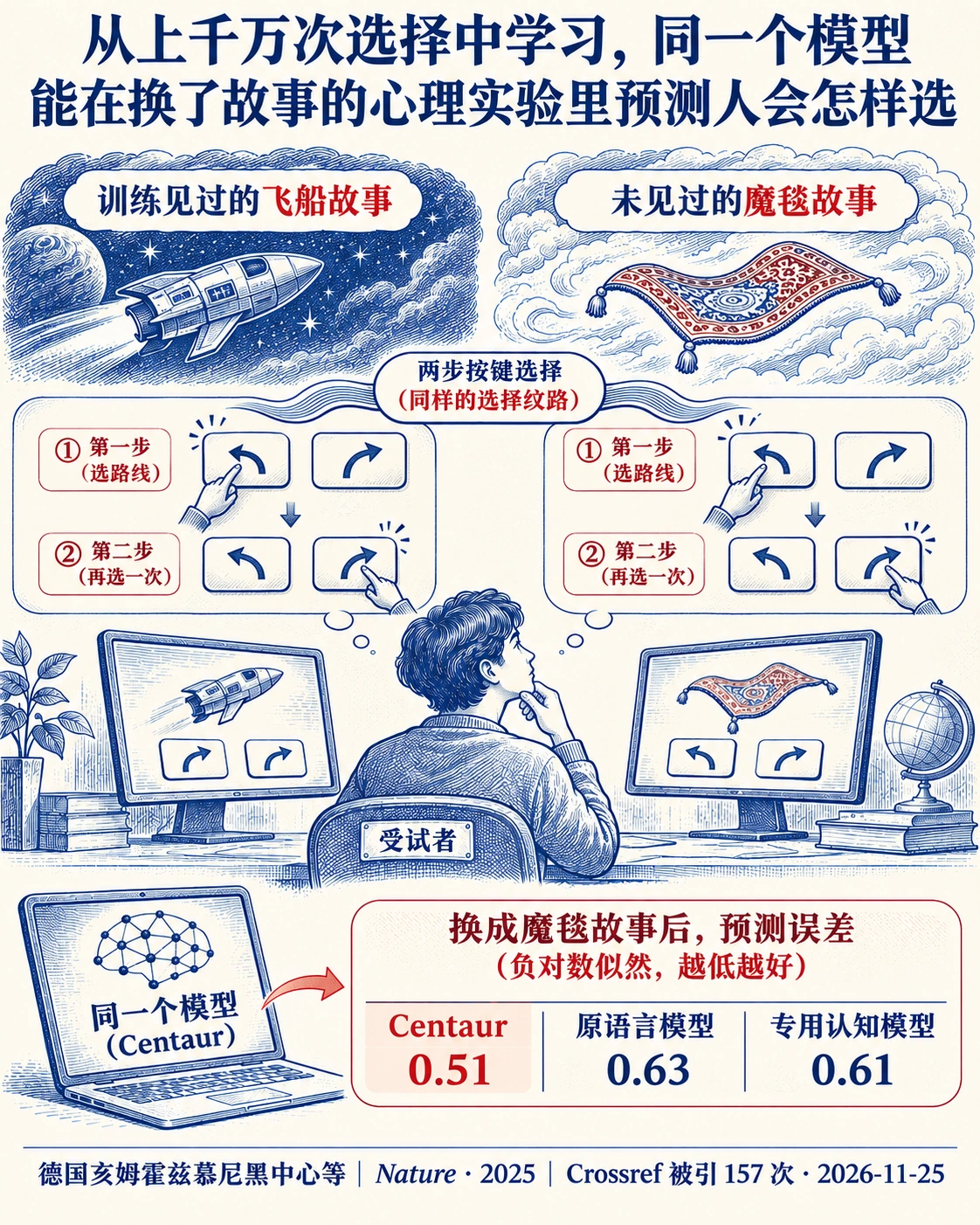
一个心理实验把宇宙飞船寻宝的故事换成魔毯,参与者仍要连续作两次选择。只在训练资料里见过飞船故事的 Centaur,在魔毯版本也比原语言模型和专用认知模型更能预测参与者的选择。
推荐阅读的理由
如果模型只是记住“选择这艘飞船”,换一个故事就可能失效。魔毯任务保留了选择结构,却替换了叙事。这个例子把整篇论文更大的问题落到了实处:从许多实验逐次的人类选择中训练出来的同一个模型,能否用来解释它没见过的场景?
A foundation model to predict and capture human cognition
作者摘要 · 中文编译
作者摘要 建立统一的认知理论是心理学长期以来的目标。迈出第一步,需要一个能在多种情境中预测人类行为的计算模型。作者提出 Centaur,希望在能以自然语言描述的实验中预测和模拟人的行为。他们在一个称为 Psych-101 的大规模数据集上微调语言模型。该数据集含 160 个心理实验,记录逾 6 万人逐次作出的超过 1,000 万个选择。
研究发现 在留作测试的参与者身上,Centaur 对行为的预测优于已有认知模型,并且能推广到未见过的背景故事、任务结构变动及全新任务领域。微调后,模型的内部表征也比原来更接近人类神经活动。作者认为,这说明可以建立跨领域捕捉人类行为的计算模型,并提供一个用模型指导认知理论发展的案例。
展开英文原摘要收起英文原摘要Establishing a unified theory of cognition has been an important goal in psychology1,2. A first step towards such a theory is to create a computational model that can predict human behaviour in a wide range of settings. Here we introduce Centaur, a computational model that can predict and simulate human behaviour in any experiment expressible in natural language. We derived Centaur by fine-tuning a state-of-the-art language model on a large-scale dataset called Psych-101. Psych-101 has an unprecedented scale, covering trial-by-trial data from more than 60,000 participants performing in excess of 10,000,000 choices in 160 experiments. Centaur not only captures the behaviour of held-out participants better than existing cognitive models, but it also generalizes to previously unseen cover stories, structural task modifications and entirely new domains. Furthermore, the model’s internal representations become more aligned with human neural activity after fine-tuning. Taken together, our results demonstrate that it is possible to discover computational models that capture human behaviour across a wide range of domains. We believe that such models provide tremendous potential for guiding the development of cognitive theories, and we present a case study to demonstrate this.
Establishing a unified theory of cognition has been an important goal in psychology1,2. A first step towards such a theory is to create a computational model that can predict human behaviour in a wide range of settings. Here we introduce Centaur, a computational model that can predict and simulate human behaviour in any experiment expressible in natural language. We derived Centaur by fine-tuning a state-of-the-art language model on a large-scale dataset called Psych-101. Psych-101 has an unprecedented scale, covering trial-by-trial data from more than 60,000 participants performing in excess of 10,000,000 choices in 160 experiments. Centaur not only captures the behaviour of held-out participants better than existing cognitive models, but it also generalizes to previously unseen cover stories, structural task modifications and entirely new domains. Furthermore, the model’s internal representations become more aligned with human neural activity after fine-tuning. Taken together, our results demonstrate that it is possible to discover computational models that capture human behaviour across a wide range of domains. We believe that such models provide tremendous potential for guiding the development of cognitive theories, and we present a case study to demonstrate this.
Marcel Binz, Elif Akata, Matthias Bethge, Franziska Brändle, Fred Callaway, Julian Coda-Forno, Peter Dayan, Can Demircan, Maria K Eckstein, Noémi Éltető, Thomas L Griffiths, Susanne Haridi, Akshay K Jagadish, Li Ji-An, Alexander Kipnis, Sreejan Kumar, Tobias Ludwig, Marvin Mathony, Marcelo Mattar, Alireza Modirshanechi, Surabhi S Nath, Joshua C Peterson, Milena Rmus, Evan M Russek, Tankred Saanum, Johannes A Schubert, Luca M Schulze Buschoff, Nishad Singhi, Xin Sui, Mirko Thalmann, Fabian J Theis, Vuong Truong, Vishaal Udandarao, Konstantinos Voudouris, Robert Wilson, Kristin Witte, Shuchen Wu, Dirk U Wulff, Huadong Xiong, Eric Schulz
© The Author(s) 2025
一个没见过的故事,三种模型预测得如何?
| 预测方法 | 魔毯实验的负对数似然(越低越好) |
|---|---|
| Centaur | 0.51 |
| 未经此次微调的语言模型 | 0.63 |
| 该任务的专用认知模型 | 0.61 |
这是原文图 3a 的一个迁移实例。整篇研究还测试了不同任务结构及新领域。 核对作者图表
作者的结论
作者认为,可以训练同一个计算模型,在不同心理实验中捕捉和预测人类行为。新故事、任务结构变化和新领域的测试为这种推广能力提供了证据,模型也可用于提出新的认知理论假设。
研究团队与论文影响
德国亥姆霍兹慕尼黑中心等团队建立 Psych-101,汇集 160 个实验、超过 6 万人做的逾 1,000 万次选择。论文发表于 Nature,并提供多个留出情境验证。
Crossref 收录本文引用 157 次。出版商统计本文访问约 31.7 万次。Nature 的 2025 年期刊影响因子为 56.1。
单篇与期刊指标核查于 。
原文与延伸阅读
- Nature 原始论文
- 作者公开的 Psych-101 数据说明
- 认知科学研究者对预测与解释的讨论
- 期刊论文与作者摘要
- 原文图表
- 本文的全文与图表
- Crossref 单篇引用记录
- 本文的出版商访问记录
- 出版商的年度期刊指标
引用这篇文章与反馈纠错
研象编辑部.从上千万次选择中学习,同一个模型能在换了故事的心理实验里预测人会怎样选[EB/OL].研象,2026-11-25.https://yanxiang.hk/papers/centaur-behaviour
发现数字、译文或出处有误,可以在邮件里指出相应段落,附上核对依据。