
从眼底照估计病变进展时间,模型推演的糖尿病眼病平均复查间隔可从一年延到近 32 个月
Nature Medicine2024预测模型验证Crossref 记录被引 340 次
两位患者今天的眼底检查相似,下次都应同一天回来吗?
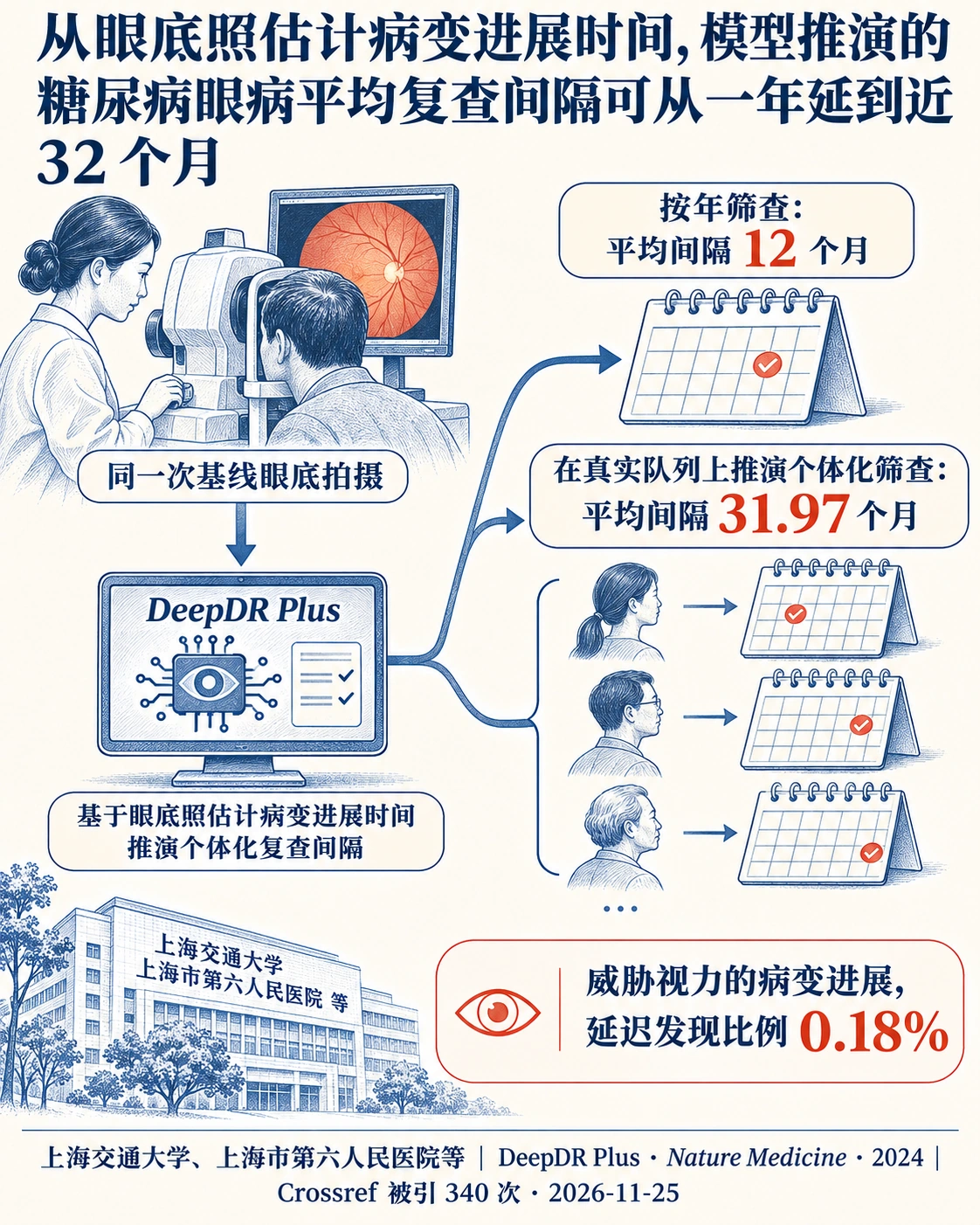
用一次眼底照估计糖尿病视网膜病变何时进展,再据此安排复查。在真实人群数据上推演这套安排,平均筛查间隔可从 12 个月延长到 31.97 个月,威胁视力的病变进展延迟发现比例为 0.18%。
推荐阅读的理由
固定一年复查很容易执行,却忽略了病情进展速度的差别。作者先预测何时进展,再用队列随访记录回头检查:如果按这张新日历复查,会少做多少检查,有多少进展会比按年复查发现得晚?把这两个数一起看,才能理解延长间隔的代价。
A deep learning system for predicting time to progression of diabetic retinopathy
作者摘要 · 中文编译
作者摘要 糖尿病视网膜病变是全球可预防失明的重要原因。不同患者进展风险差异很大,难以预测谁该何时复查。作者开发并验证 DeepDR Plus,仅从眼底图像预测五年内病变进展的时间。最初用 179,327 名糖尿病患者的 717,308 张图像预训练,再用含 29,868 名患者、118,868 张图像的多族裔数据进行训练和验证。
结果与结论 五年内预测进展时间的 C 指数为 0.754 至 0.846,综合 Brier 分数为 0.153 至 0.241;作者进一步在真实世界队列中验证。如果按系统建议纳入流程,平均筛查间隔可从 12 个月延长至 31.97 个月。建议间隔为 1、2、3、4、5 年的参与者分别占 30.62%、20.00%、19.63%、11.85% 和 17.89%。威胁视力的病变进展延迟发现比例为 0.18%。作者认为,系统可能用于预测个人五年内的进展风险和时间,帮助安排不同的复查间隔。
展开英文原摘要收起英文原摘要Diabetic retinopathy (DR) is the leading cause of preventable blindness worldwide. The risk of DR progression is highly variable among different individuals, making it difficult to predict risk and personalize screening intervals. We developed and validated a deep learning system (DeepDR Plus) to predict time to DR progression within 5 years solely from fundus images. First, we used 717,308 fundus images from 179,327 participants with diabetes to pretrain the system. Subsequently, we trained and validated the system with a multiethnic dataset comprising 118,868 images from 29,868 participants with diabetes. For predicting time to DR progression, the system achieved concordance indexes of 0.754–0.846 and integrated Brier scores of 0.153–0.241 for all times up to 5 years. Furthermore, we validated the system in real-world cohorts of participants with diabetes. The integration with clinical workflow could potentially extend the mean screening interval from 12 months to 31.97 months, and the percentage of participants recommended to be screened at 1–5 years was 30.62%, 20.00%, 19.63%, 11.85% and 17.89%, respectively, while delayed detection of progression to vision-threatening DR was 0.18%. Altogether, the DeepDR Plus system could predict individualized risk and time to DR progression over 5 years, potentially allowing personalized screening intervals.
Diabetic retinopathy (DR) is the leading cause of preventable blindness worldwide. The risk of DR progression is highly variable among different individuals, making it difficult to predict risk and personalize screening intervals. We developed and validated a deep learning system (DeepDR Plus) to predict time to DR progression within 5 years solely from fundus images. First, we used 717,308 fundus images from 179,327 participants with diabetes to pretrain the system. Subsequently, we trained and validated the system with a multiethnic dataset comprising 118,868 images from 29,868 participants with diabetes. For predicting time to DR progression, the system achieved concordance indexes of 0.754–0.846 and integrated Brier scores of 0.153–0.241 for all times up to 5 years. Furthermore, we validated the system in real-world cohorts of participants with diabetes. The integration with clinical workflow could potentially extend the mean screening interval from 12 months to 31.97 months, and the percentage of participants recommended to be screened at 1–5 years was 30.62%, 20.00%, 19.63%, 11.85% and 17.89%, respectively, while delayed detection of progression to vision-threatening DR was 0.18%. Altogether, the DeepDR Plus system could predict individualized risk and time to DR progression over 5 years, potentially allowing personalized screening intervals.
Ling Dai, Bin Sheng, Tingli Chen, Qiang Wu, Ruhan Liu, Chun Cai, Liang Wu, Dawei Yang, Haslina Hamzah, Yuexing Liu, Xiangning Wang, Zhouyu Guan, Shujie Yu, Tingyao Li, Ziqi Tang, Anran Ran, Haoxuan Che, Hao Chen, Yingfeng Zheng, Jia Shu, Shan Huang, Chan Wu, Shiqun Lin, Dan Liu, Jiajia Li, Zheyuan Wang, Ziyao Meng, Jie Shen, Xuhong Hou, Chenxin Deng, Lei Ruan, Feng Lu, Miaoli Chee, Ten Cheer Quek, Ramyaa Srinivasan, Rajiv Raman, Xiaodong Sun, Ya Xing Wang, Jiarui Wu, Hai Jin, Rongping Dai, Dinggang Shen, Xiaokang Yang, Minyi Guo, Cuntai Zhang, Carol Y Cheung, Gavin Siew Wei Tan, Yih-Chung Tham, Ching-Yu Cheng, Huating Li, Tien Yin Wong, Weiping Jia
© The Author(s) 2024
个体化安排在已有队列中推演出的结果
| 推演指标 | 眼底图像模型 |
|---|---|
| 平均检查间隔 | 31.97 个月(固定年度为 12 个月) |
| 人群筛查频次减少 | 62.46% |
| 任何病变进展延迟发现 | 1.05% |
| 威胁视力的进展延迟发现 | 0.18% |
取原文表 3 两个队列合并的结果。 核对作者图表
作者的结论
作者认为,DeepDR Plus 有能力只凭基线眼底图像估计五年内个体进展的风险与时间,可能支持个体化复查间隔。31.97 个月是采用推荐间隔的推演结果。
研究团队与论文影响
上海交通大学、上海市第六人民医院等团队建立系统,用多族裔数据训练和验证,再放入真实世界人群数据进行检验。
Crossref 收录本文引用 340 次。出版商统计本文访问约 8.2 万次。
单篇与期刊指标核查于 。
原文与延伸阅读
引用这篇文章与反馈纠错
研象编辑部.从眼底照估计病变进展时间,模型推演的糖尿病眼病平均复查间隔可从一年延到近 32 个月[EB/OL].研象,2026-11-25.https://yanxiang.hk/papers/deepdr-plus-personal-screening
发现数字、译文或出处有误,可以在邮件里指出相应段落,附上核对依据。