
急诊低估病情时,蛛网膜下腔出血和主动脉夹层的部分关键医嘱开得更晚
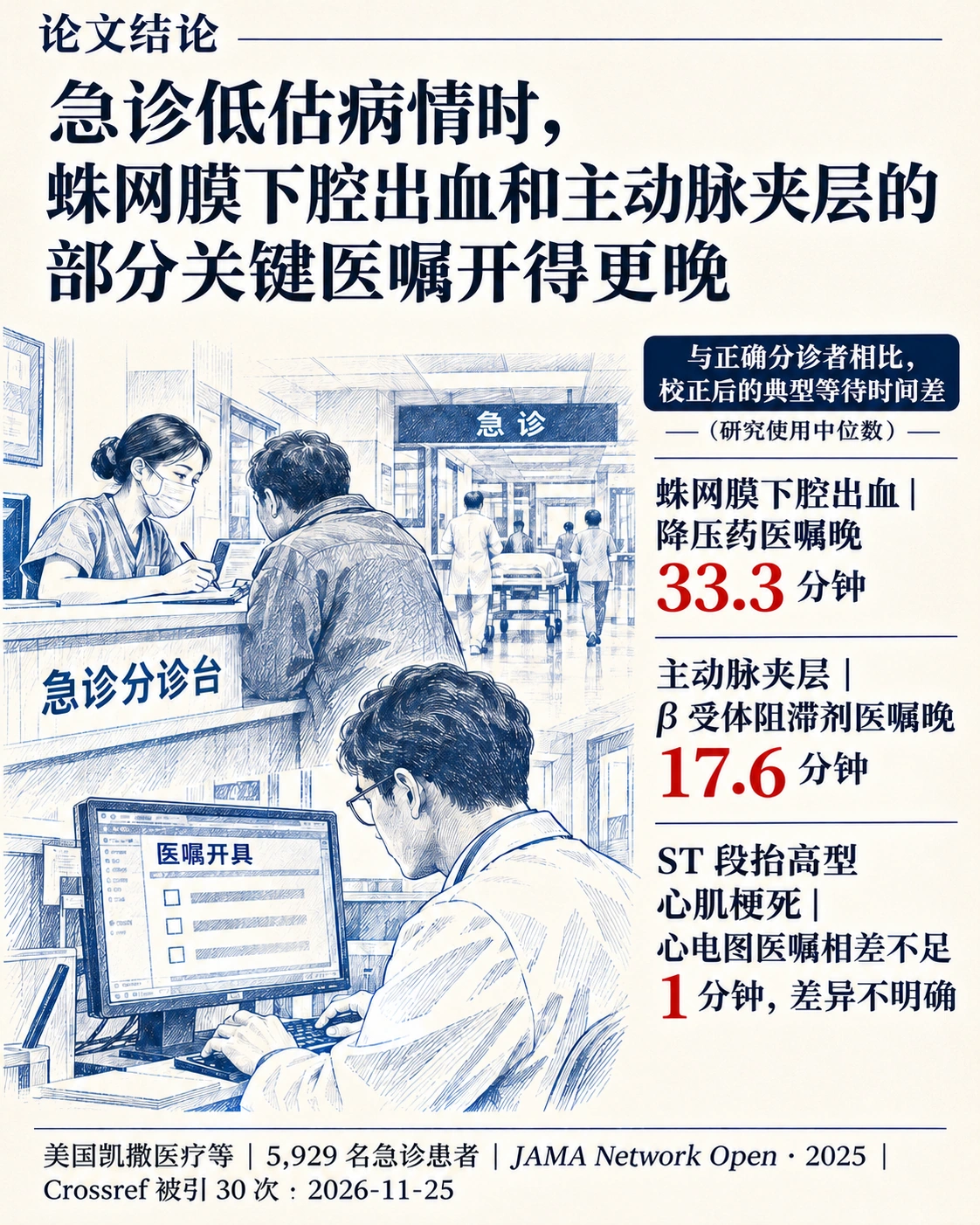
JAMA Network Open2025队列研究Crossref 记录被引 30 次
分诊低估以后,哪个环节真的慢了?
在美国急诊记录中,蛛网膜下腔出血或主动脉夹层患者若被分到比病情所需更低的紧急等级,部分关键检查和药物医嘱开得更晚。ST 段抬高型心肌梗死患者的心电图和肌钙蛋白医嘱几乎没有这种时间差。
推荐阅读的理由
一张笼统的急诊停留时间表,很难告诉人该改哪个流程。作者把到达、开检查、开药和离开急诊的记录按疾病拆开。主动脉夹层患者的胸部 CT 医嘱约晚 9 分钟,β 受体阻滞剂医嘱约晚 18 分钟;心梗患者的两种关键检查医嘱差异都不到一分钟。
Emergency Department Triage Accuracy and Delays in Care for High-Risk Conditions
作者摘要 · 中文编译
背景与目的 急诊分诊可能影响高风险患者及时得到照护。作者考察分诊级别偏低,与蛛网膜下腔出血、主动脉夹层或 ST 段抬高型心肌梗死患者的诊疗延迟是否相关。
设计 在一个多中心社区型医疗系统内,回顾 2016 年 1 月 1 日至 2020 年 12 月 31 日从急诊确诊上述疾病的成年人。按实际分诊偏差的操作性标准,比较低估和正确分诊者。2023 年 3 月至 2024 年 10 月分析。使用对数正态模型估计中位等待时间:对蛛网膜下腔出血和主动脉夹层患者分别考察无增强头部或胸部 CT、降压药或 β 受体阻滞剂医嘱及急诊停留时间,对心肌梗死患者考察心电图与肌钙蛋白医嘱。
结果 5,929 名患者年龄中位数 63 岁(四分位间距 54 至 73),3,876 人(65.4%)为男性。蛛网膜下腔出血 915 人、主动脉夹层 480 人、ST 段抬高型心肌梗死 4,534 人。亚裔 1,129 人(19.0%)、黑人 553 人(9.3%)、西班牙裔 889 人(15.0%)、非西班牙裔白人 2,906 人(49.0%)。共有 2,175 人(36.7%)分诊级别偏低。蛛网膜下腔出血患者头部 CT 医嘱晚 2.4 分钟(原文对数正态模型估计 0.2,95% 置信区间 0.0 至 0.3),降压药医嘱晚 33.3 分钟(4.8,3.6 至 5.9),急诊停留延长 7.7 分钟(0.1,0.0 至 0.1)。主动脉夹层患者胸部 CT 晚 8.9 分钟(0.2,0.0 至 0.4),β 受体阻滞剂医嘱晚 17.6 分钟(0.5,0.2 至 0.7),急诊停留时间延长 64 分钟(0.2,0.1 至 0.3)。心肌梗死患者的心电图和肌钙蛋白医嘱时间差均不足 1 分钟,未达统计学显著。
结论 在这项队列研究中,分诊级别偏低与蛛网膜下腔出血和主动脉夹层患者的一些关键诊断及治疗医嘱出现较小但有统计学意义的延迟相关,心肌梗死患者未见这种关联。
展开英文原摘要收起英文原摘要Emergency department (ED) triage may impact timeliness of care for high-risk conditions. To determine the association of ED undertriage with delays in care for patients with subarachnoid hemorrhage (SAH), aortic dissection (AD), and ST-elevation myocardial infarction (STEMI). This retrospective cohort study included adult ED patients diagnosed with SAH, AD, or STEMI from January 1, 2016, to December 31, 2020, from a multicenter, community-based health care delivery system. Data analysis were completed in March 2023 to October 2024. Undertriage vs correct triage, defined by operational measures of mistriage. Using a lognormal distribution, the outcomes of interest for patients with SAH and AD were adjusted median time to noncontrast computed tomography (CT) (head CT for patients with SAH, chest CT for patients with AD), antihypertensive medication orders (SAH), and β-blocker orders (AD), and ED length of stay (LOS). For patients with STEMI, outcomes of interest were adjusted median time to electrocardiogram (ECG) and troponin orders. A total of 5929 patients (median [IQR] age, 63.0 [54.0 to 73.0] years; 3876 [65.4%] male) were identified, including 915 with SAH, 480 with AD, and 4534 with STEMI. There were 1129 Asian patients (19.0%), 553 Black patients (9.3%), 889 Hispanic patients (15.0%), and 2906 non-Hispanic White patients (49.0%). Overall, 2175 patients (36.7%) were undertriaged. For patients with SAH, the lognormal estimate for delay in time to head CT was 0.2 (95% CI, 0.0-0.3), or a delay of 2.4 minutes, and for antihypertensive orders, the lognormal estimate was 4.8 (95% CI, 3.6-5.9), or a delay of 33.3 minutes; the lognormal estimate for ED LOS was 0.1 (95% CI, 0.0-0.1), or 7.7 minutes longer. For patients with AD, the lognormal estimate for delays were 0.2 (95% CI, 0.0-0.4), or 8.9 minutes, for chest CT and 0.5 (95% CI, 0.2-0.7), or 17.6 minutes, for β-blocker orders, and ED LOS was 0.2 (95% CI, 0.1-0.3), or 64 minutes longer. For patients with STEMI, differences in time to ECG and troponin orders were not statistically significant, at less than 1 minute, comparing correctly and undertriaged patients. In this cohort study of patients diagnosed with SAH, AD, or STEMI, ED undertriage was associated with small but significant delays in key diagnostic and therapeutic orders for patients with SAH and AD but not for patients with STEMI.
Importance · Emergency department (ED) triage may impact timeliness of care for high-risk conditions.
Objective · To determine the association of ED undertriage with delays in care for patients with subarachnoid hemorrhage (SAH), aortic dissection (AD), and ST-elevation myocardial infarction (STEMI).
Design, Setting, and Participants · This retrospective cohort study included adult ED patients diagnosed with SAH, AD, or STEMI from January 1, 2016, to December 31, 2020, from a multicenter, community-based health care delivery system. Data analysis were completed in March 2023 to October 2024.
Exposure · Undertriage vs correct triage, defined by operational measures of mistriage.
Main Outcomes and Measures · Using a lognormal distribution, the outcomes of interest for patients with SAH and AD were adjusted median time to noncontrast computed tomography (CT) (head CT for patients with SAH, chest CT for patients with AD), antihypertensive medication orders (SAH), and β-blocker orders (AD), and ED length of stay (LOS). For patients with STEMI, outcomes of interest were adjusted median time to electrocardiogram (ECG) and troponin orders.
Results · A total of 5929 patients (median [IQR] age, 63.0 [54.0 to 73.0] years; 3876 [65.4%] male) were identified, including 915 with SAH, 480 with AD, and 4534 with STEMI. There were 1129 Asian patients (19.0%), 553 Black patients (9.3%), 889 Hispanic patients (15.0%), and 2906 non-Hispanic White patients (49.0%). Overall, 2175 patients (36.7%) were undertriaged. For patients with SAH, the lognormal estimate for delay in time to head CT was 0.2 (95% CI, 0.0-0.3), or a delay of 2.4 minutes, and for antihypertensive orders, the lognormal estimate was 4.8 (95% CI, 3.6-5.9), or a delay of 33.3 minutes; the lognormal estimate for ED LOS was 0.1 (95% CI, 0.0-0.1), or 7.7 minutes longer. For patients with AD, the lognormal estimate for delays were 0.2 (95% CI, 0.0-0.4), or 8.9 minutes, for chest CT and 0.5 (95% CI, 0.2-0.7), or 17.6 minutes, for β-blocker orders, and ED LOS was 0.2 (95% CI, 0.1-0.3), or 64 minutes longer. For patients with STEMI, differences in time to ECG and troponin orders were not statistically significant, at less than 1 minute, comparing correctly and undertriaged patients.
Conclusions and Relevance · In this cohort study of patients diagnosed with SAH, AD, or STEMI, ED undertriage was associated with small but significant delays in key diagnostic and therapeutic orders for patients with SAH and AD but not for patients with STEMI.
Dana R Sax, E Margaret Warton, Dustin G Mark, Mary E Reed
Copyright 2025 Sax DR et al. JAMA Network Open.
分诊级别偏低的患者,哪些医嘱晚了多久?
| 疾病 | 检查医嘱时间差 | 其他医嘱或停留时间 |
|---|---|---|
| 蛛网膜下腔出血 | 头颅 CT 晚约 2.4 分钟 | 降压药晚约 33.3 分钟 |
| 主动脉夹层 | 胸部 CT 晚约 8.9 分钟 | β 受体阻滞剂晚约 17.6 分钟 |
| ST 段抬高型心肌梗死 | 心电图差异不足 1 分钟 | 肌钙蛋白医嘱差异不足 1 分钟 |
三类疾病依次对应原文图 1 至 3。心肌梗死组的两项差异均未达统计学显著。 核对作者图表
作者的结论
作者认为,在三类急症中,分诊级别偏低与蛛网膜下腔出血、主动脉夹层部分诊疗医嘱的延迟有关。ST 段抬高型心肌梗死的相关医嘱时间未显示显著差别。研究测的是开立医嘱的时间。
研究团队与论文影响
美国凯撒医疗的一组社区型急诊共同提供常规医疗记录。团队纳入 2016 至 2020 年确诊三类高风险疾病的 5,929 名成年人,并在同病种内比较分诊正确和分诊级别偏低的人。
Crossref 收录本文引用 30 次。JAMA Network Open 在 2025 年度回顾中列出的期刊影响因子为 9.7。
单篇与期刊指标核查于 。
原文与延伸阅读
引用这篇文章与反馈纠错
研象编辑部.急诊低估病情时,蛛网膜下腔出血和主动脉夹层的部分关键医嘱开得更晚[EB/OL].研象,2026-11-25.https://yanxiang.hk/papers/emergency-undertriage-high-risk-conditions
发现数字、译文或出处有误,可以在邮件里指出相应段落,附上核对依据。