
听力干预三年后,听损老人平均多保住一位常联系的人
JAMA Internal Medicine2025随机对照试验研究团队与论文影响
声音听清以后,平时联系的人也会变吗?
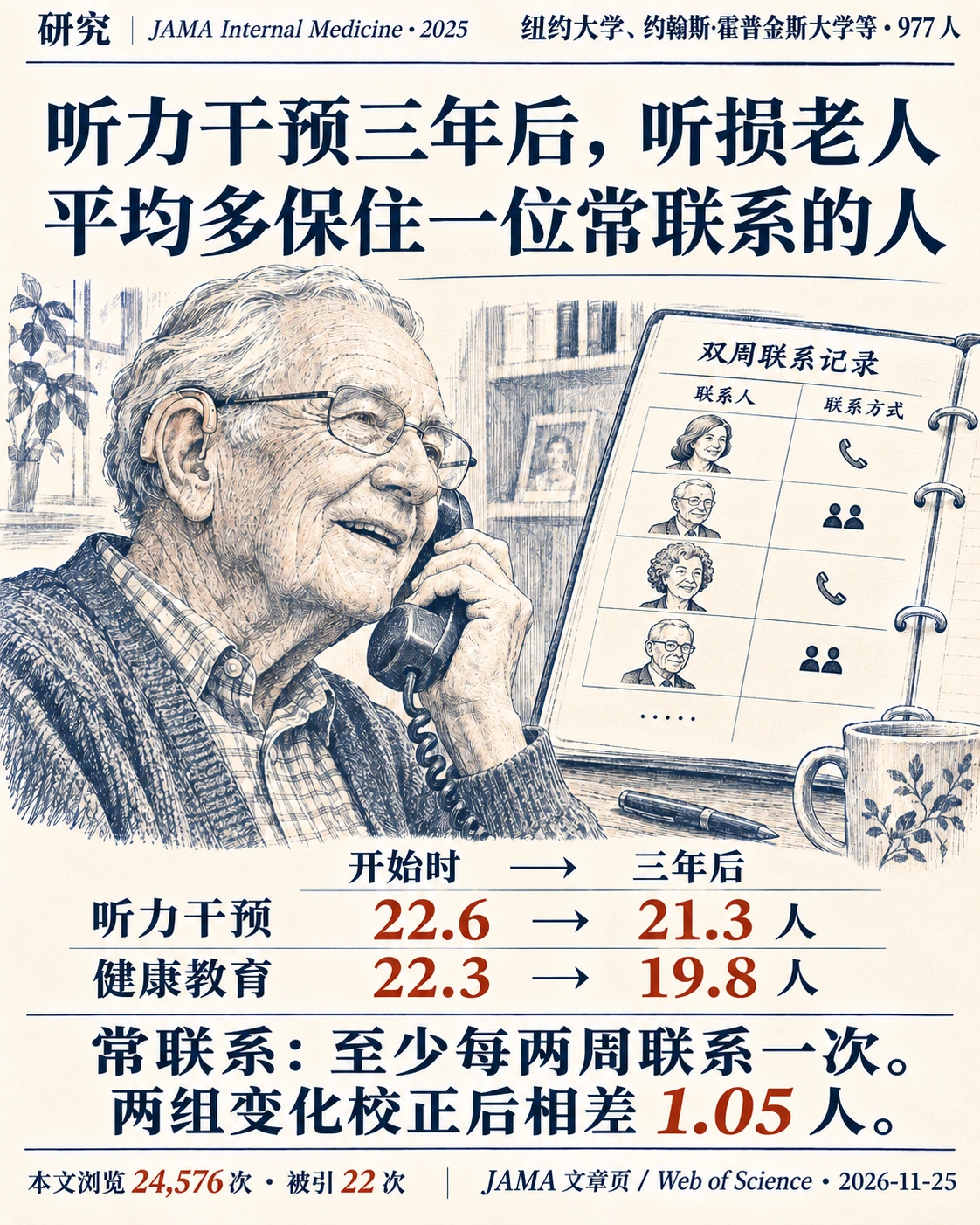
听力干预三年后,两组老人的常联系人数都减少了。与只接受健康教育的老人相比,接受助听器、调试和听力咨询的老人平均多保留了约一位联系人。
推荐阅读的理由
想想一通原本每周都打的电话。如果交流越来越费力,这通电话可能会慢慢减少。研究团队没有请老人想象这种情形,而是反复记录各类关系里实际联系的人数。值得细看的是,两组的联系人都在减少;差别在于减少的速度。主观孤独感另外打分,改善幅度很小。
Hearing Intervention, Social Isolation, and Loneliness: A Secondary Analysis of the ACHIEVE Randomized Clinical Trial
作者摘要 · 中文编译
背景与目的 促进老年人保持社交联系是一项公共卫生工作。改善听力可能减少社交孤立和孤独感。研究者在 ACHIEVE 研究中比较了规范听力干预与健康教育在三年内对这两方面的影响。
设计与人群 这项多中心随机试验的次要分析涵盖美国四个研究点,分别位于北卡罗来纳州福赛斯县、密西西比州杰克逊、明尼苏达州明尼阿波利斯和马里兰州华盛顿县。三年随访于 2022 年完成,数据于 2024 年分析。977 名参与者年龄为 70 至 84 岁,均有未经治疗的听力损失,无明显认知障碍。其中 238 人(24.4%)来自社区动脉粥样硬化风险研究,739 人(75.6%)为新招募。研究按 1∶1 随机分配,每半年随访一次。
干预与测量 听力干预组与认证听力师会面四次,接受助听器、咨询和教育。对照组与认证健康教育者会面四次,学习慢性病和失能预防。社交孤立用 Cohen 社交网络指数衡量,孤独感用 UCLA 孤独量表衡量。这些探索性指标在研究开始以及干预后 6 个月、1 年、2 年和 3 年测量。研究按最初分组,用两层线性混合效应模型估计干预效果。
结果 参与者平均 76.3 岁(标准差 4.0),523 人为女性(53.5%),112 人为黑人(11.5%),858 人为白人(87.8%),521 人具有学士或更高学位(53.4%)。较好耳的纯音平均听阈为 39.4 分贝(标准差 6.9)。平均常联系人数,听力干预组从 22.6(标准差 11.1)降到 21.3(11.0),健康教育组从 22.3(10.2)降到 19.8(10.2)。校正后,与对照组相比,听力干预组在社交网络人数上相差 1.05 人(95% 置信区间 0.01 至 2.09),关系种类多样性相差 0.19(0.02 至 0.36),参与不同关系网络的程度相差 0.27(0.09 至 0.44),孤独量表得分相差 −0.94(−1.78 至 −0.11)。按招募来源分别分析,按实际遵循方案程度分析,估算依从者的平均因果效应,或更换校正变量,结果均无实质变化。
结论 这项随机试验的次要分析表明,与健康教育相比,听力干预使听损老人三年后在社交网络中平均多保留一位联系人。人数的差异有统计学意义,其临床意义仍未知。孤独量表的变化未达到临床上有意义的程度。听力干预风险较低,可能帮助老年人保持社交联系。
注册 ClinicalTrials.gov 编号 NCT03243422。
展开英文原摘要收起英文原摘要Promoting social connection among older adults is a public health priority. Addressing hearing loss may reduce social isolation and loneliness among older adults. To describe the effect of a best-practice hearing intervention vs health education control on social isolation and loneliness over a 3-year period in the Aging and Cognitive Health Evaluation in Elders (ACHIEVE) study. This secondary analysis of a multicenter randomized controlled trial with 3-year follow-up was completed in 2022 and conducted at 4 field sites in the US (Forsyth County, North Carolina; Jackson, Mississippi; Minneapolis, Minnesota; Washington County, Maryland). Data were analyzed in 2024. Participants included 977 adults (aged 70-84 years who had untreated hearing loss without substantial cognitive impairment) recruited from the Atherosclerosis Risk in Communities study (238 [24.4%]) and newly recruited (de novo; 739 [75.6%]). Participants were randomized (1:1) to hearing intervention or health education control and followed up every 6 months. Hearing intervention (4 sessions with certified study audiologist, hearing aids, counseling, and education) and health education control (4 sessions with a certified health educator on chronic disease, disability prevention). Social isolation (Cohen Social Network Index score) and loneliness (UCLA Loneliness Scale score) were exploratory outcomes measured at baseline and at 6 months and 1, 2, and 3 years postintervention. The intervention effect was estimated using a 2-level linear mixed-effects model under the intention-to-treat principle. Among the 977 participants, the mean (SD) age was 76.3 (4.0) years; 523 (53.5%) were female, 112 (11.5%) were Black, 858 (87.8%) were White, and 521 (53.4%) had a Bachelor’s degree or higher. The mean (SD) better-ear pure-tone average was 39.4 dB (6.9). Over 3 years, mean (SD) social network size reduced from 22.6 (11.1) to 21.3 (11.0) and 22.3 (10.2) to 19.8 (10.2) people over 2 weeks in the hearing intervention and health education control arms, respectively. In fully adjusted models, hearing intervention (vs health education control) reduced social isolation (social network size [difference, 1.05; 95% CI, 0.01-2.09], diversity [difference, 0.19; 95% CI, 0.02-0.36], embeddedness [difference, 0.27; 95% CI, 0.09-0.44], and reduced loneliness [difference, −0.94; 95% CI, −1.78 to −0.11]) over 3 years. Results were substantively unchanged in sensitivity analyses that incorporated models that were stratified by recruitment source, analyzed per protocol and complier average causal effect, or that varied covariate adjustment. This secondary analysis of a randomized clinical trial indicated that older adults with hearing loss retained 1 additional person in their social network relative to a health education control over 3 years. While statistically significant, it is unknown whether observed changes in social network are clinically meaningful, and loneliness measure changes do not represent clinically meaningful changes. Hearing intervention is a low-risk strategy that may help promote social connection among older adults. ClinicalTrials.gov Identifier: NCT03243422
Importance · Promoting social connection among older adults is a public health priority. Addressing hearing loss may reduce social isolation and loneliness among older adults.
Objective · To describe the effect of a best-practice hearing intervention vs health education control on social isolation and loneliness over a 3-year period in the Aging and Cognitive Health Evaluation in Elders (ACHIEVE) study.
Design, Setting, and Participants · This secondary analysis of a multicenter randomized controlled trial with 3-year follow-up was completed in 2022 and conducted at 4 field sites in the US (Forsyth County, North Carolina; Jackson, Mississippi; Minneapolis, Minnesota; Washington County, Maryland). Data were analyzed in 2024. Participants included 977 adults (aged 70-84 years who had untreated hearing loss without substantial cognitive impairment) recruited from the Atherosclerosis Risk in Communities study (238 [24.4%]) and newly recruited (de novo; 739 [75.6%]). Participants were randomized (1:1) to hearing intervention or health education control and followed up every 6 months.
Interventions · Hearing intervention (4 sessions with certified study audiologist, hearing aids, counseling, and education) and health education control (4 sessions with a certified health educator on chronic disease, disability prevention).
Main Outcomes and Measures · Social isolation (Cohen Social Network Index score) and loneliness (UCLA Loneliness Scale score) were exploratory outcomes measured at baseline and at 6 months and 1, 2, and 3 years postintervention. The intervention effect was estimated using a 2-level linear mixed-effects model under the intention-to-treat principle.
Results · Among the 977 participants, the mean (SD) age was 76.3 (4.0) years; 523 (53.5%) were female, 112 (11.5%) were Black, 858 (87.8%) were White, and 521 (53.4%) had a Bachelor’s degree or higher. The mean (SD) better-ear pure-tone average was 39.4 dB (6.9). Over 3 years, mean (SD) social network size reduced from 22.6 (11.1) to 21.3 (11.0) and 22.3 (10.2) to 19.8 (10.2) people over 2 weeks in the hearing intervention and health education control arms, respectively. In fully adjusted models, hearing intervention (vs health education control) reduced social isolation (social network size [difference, 1.05; 95% CI, 0.01-2.09], diversity [difference, 0.19; 95% CI, 0.02-0.36], embeddedness [difference, 0.27; 95% CI, 0.09-0.44], and reduced loneliness [difference, −0.94; 95% CI, −1.78 to −0.11]) over 3 years. Results were substantively unchanged in sensitivity analyses that incorporated models that were stratified by recruitment source, analyzed per protocol and complier average causal effect, or that varied covariate adjustment.
Conclusions and Relevance · This secondary analysis of a randomized clinical trial indicated that older adults with hearing loss retained 1 additional person in their social network relative to a health education control over 3 years. While statistically significant, it is unknown whether observed changes in social network are clinically meaningful, and loneliness measure changes do not represent clinically meaningful changes. Hearing intervention is a low-risk strategy that may help promote social connection among older adults.
Trial Registration · ClinicalTrials.gov Identifier: NCT03243422
Nicholas S Reed, Jinyu Chen, Alison R Huang, James R Pike, Michelle Arnold, Sheila Burgard, Ziheng Chen, Theresa Chisolm, David Couper, Thomas K M Cudjoe, Jennifer A Deal, Adele M Goman, Nancy W Glynn, Theresa Gmelin, Lisa Gravens-Mueller, Kathleen M Hayden, Christine M Mitchell, Thomas Mosley, Esther S Oh, James S Pankow, Victoria A Sanchez, Jennifer A Schrack, Josef Coresh, Frank R Lin, ACHIEVE Collaborative Research Group
Copyright 2025 Reed NS et al. JAMA Internal Medicine.
随着三年过去,老人还与多少人保持经常联系?
| 平均联系人数 | 研究开始时 | 三年后 |
|---|---|---|
| 听力干预 | 22.6 人 | 21.3 人 |
| 健康教育 | 22.3 人 | 19.8 人 |
图 2 展示各随访时间的变化,图 3 给出校正后的比较。两组人数变化相差 1.05 人,95% 置信区间为 0.01 至 2.09。 核对作者图表
作者的结论
作者认为,整套听力干预可能帮助听损老人维持社交联系。平均相差一位联系人对生活意味着多大改变,仍有待研究。孤独感评分的变化没有达到具有临床意义的程度。
研究团队与论文影响
纽约大学格罗斯曼医学院、约翰斯·霍普金斯大学等合作完成。这是美国四个研究点参加的 ACHIEVE 随机试验预先设定的次要分析。研究评价的是助听器加听力师指导这一整套服务。
期刊文章页记录本文浏览 24,576 次,Web of Science 被引 22 次。期刊 2025 年度回顾列出的影响因子为 23.3。
单篇与期刊指标核查于 。
原文与延伸阅读
引用这篇文章与反馈纠错
研象编辑部.听力干预三年后,听损老人平均多保住一位常联系的人[EB/OL].研象,2026-11-25.https://yanxiang.hk/papers/hearing-intervention-social-network
发现数字、译文或出处有误,可以在邮件里指出相应段落,附上核对依据。