
撒哈拉以南非洲三十六国的调查中,仅四国的医保覆盖率超过两成
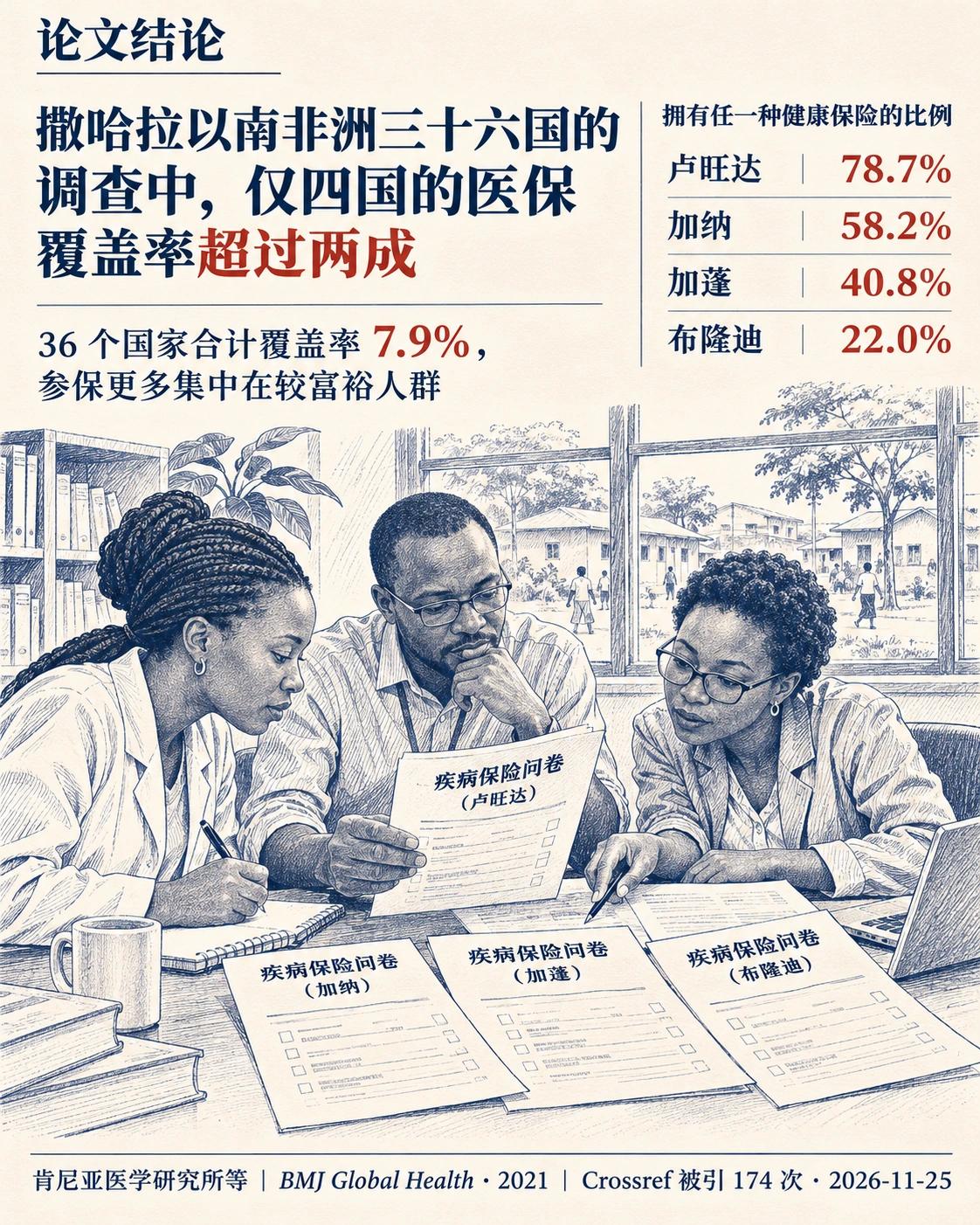
BMJ Global Health2021横断面研究Crossref 记录被引 174 次
为什么名单上有医保制度,许多人仍未参保?
在撒哈拉以南非洲 36 国的调查中,拥有任一种健康保险的总体比例为 7.9%,参保更多集中在较富裕者中。只有卢旺达、加纳、加蓬和布隆迪的覆盖率超过 20%。
推荐阅读的理由
如果劳动者没有固定雇主或稳定工资,靠个人定期缴费来扩大医保覆盖会遇到实际困难。作者先用住户调查看哪些人已经参保,再比较各国筹资方式。覆盖率超过两成的四个国家都用了相当规模的税收资金,给这场筹资讨论提供了现实参照。
Examining the level and inequality in health insurance coverage in 36 sub-Saharan African countries
作者摘要 · 中文编译
背景 撒哈拉以南非洲的中低收入国家日益重视通过公共缴费型医保减轻就医经济障碍及财务风险。在此背景下,研究评估 36 个国家现有医保制度覆盖了多少人,以及覆盖在不同经济阶层之间是否均衡。
方法 作者以各国最近一期人口与健康调查为资料,计算任一医保和各类型医保的平均覆盖率。通过集中曲线、集中指数及最富与最穷人群之间的绝对差和比值评估不平等,再以广义线性模型拆解个人和家庭因素与不平等的关系。
结果 任一种医保覆盖率超过 20% 的只有四国:卢旺达 78.7%(95% 置信区间 77.5% 至 79.9%)、加纳 58.2%(56.2% 至 60.1%)、加蓬 40.8%(38.2% 至 43.5%)、布隆迪 22.0%(20.7% 至 23.2%)。36 国总体为 7.9%(7.8% 至 7.9%),参保偏向较富裕者;集中指数 0.4(0.3 至 0.4,P 值小于 0.001)。在对这种分布的分解中,接触媒体的正向贡献最大(50.3%),其次是社会经济状况(44.3%)和教育水平(41.6%)。
结论 研究涉及的撒哈拉以南非洲国家医保覆盖率较低且偏向富裕者。覆盖率超过两成的四国均有相当一部分资金来自税收,其余国家多依赖自愿机制。作者认为,在非正规就业普遍的背景下,应重新考虑自愿缴费型医保的定位,把税收筹资作为可行且可持续的选择。
展开英文原摘要收起英文原摘要Low/middle-income countries (LMICs) in sub-Saharan Africa (SSA) are increasingly turning to public contributory health insurance as a mechanism for removing financial barriers to access and extending financial risk protection to the population. Against this backdrop, we assessed the level and inequality of population coverage of existing health insurance schemes in 36 SSA countries. Using secondary data from the most recent Demographic and Health Surveys, we computed mean population coverage for any type of health insurance, and for specific forms of health insurance schemes, by country. We developed concentration curves, computed concentration indices, and rich–poor differences and ratios to examine inequality in health insurance coverage. We decomposed the concentration index using a generalised linear model to examine the contribution of household and individual-level factors to the inequality in health insurance coverage. Only four countries had coverage levels with any type of health insurance of above 20% (Rwanda—78.7% (95% CI 77.5% to 79.9%), Ghana—58.2% (95% CI 56.2% to 60.1%), Gabon—40.8% (95% CI 38.2% to 43.5%), and Burundi 22.0% (95% CI 20.7% to 23.2%)). Overall, health insurance coverage was low (7.9% (95% CI 7.8% to 7.9%)) and pro-rich; concentration index=0.4 (95% CI 0.3 to 0.4, p<0.001). Exposure to media made the greatest contribution to the pro-rich distribution of health insurance coverage (50.3%), followed by socioeconomic status (44.3%) and the level of education (41.6%). Coverage of health insurance in SSA is low and pro-rich. The four countries that had health insurance coverage levels greater than 20% were all characterised by substantial funding from tax revenues. The other study countries featured predominantly voluntary mechanisms. In a context of high informality of labour markets, SSA and other LMICs should rethink the role of voluntary contributory health insurance and instead embrace tax funding as a sustainable and feasible mechanism for mobilising resources for the health sector.
Introduction · Low/middle-income countries (LMICs) in sub-Saharan Africa (SSA) are increasingly turning to public contributory health insurance as a mechanism for removing financial barriers to access and extending financial risk protection to the population. Against this backdrop, we assessed the level and inequality of population coverage of existing health insurance schemes in 36 SSA countries.
Methods · Using secondary data from the most recent Demographic and Health Surveys, we computed mean population coverage for any type of health insurance, and for specific forms of health insurance schemes, by country. We developed concentration curves, computed concentration indices, and rich–poor differences and ratios to examine inequality in health insurance coverage. We decomposed the concentration index using a generalised linear model to examine the contribution of household and individual-level factors to the inequality in health insurance coverage.
Results · Only four countries had coverage levels with any type of health insurance of above 20% (Rwanda—78.7% (95% CI 77.5% to 79.9%), Ghana—58.2% (95% CI 56.2% to 60.1%), Gabon—40.8% (95% CI 38.2% to 43.5%), and Burundi 22.0% (95% CI 20.7% to 23.2%)). Overall, health insurance coverage was low (7.9% (95% CI 7.8% to 7.9%)) and pro-rich; concentration index=0.4 (95% CI 0.3 to 0.4, p<0.001). Exposure to media made the greatest contribution to the pro-rich distribution of health insurance coverage (50.3%), followed by socioeconomic status (44.3%) and the level of education (41.6%).
Conclusion · Coverage of health insurance in SSA is low and pro-rich. The four countries that had health insurance coverage levels greater than 20% were all characterised by substantial funding from tax revenues. The other study countries featured predominantly voluntary mechanisms. In a context of high informality of labour markets, SSA and other LMICs should rethink the role of voluntary contributory health insurance and instead embrace tax funding as a sustainable and feasible mechanism for mobilising resources for the health sector.
Edwine Barasa, Jacob Kazungu, Peter Nguhiu, Nirmala Ravishankar
© Author(s) (or their employer(s)) 2021. Re-use permitted under CC BY. Published by BMJ.
超过两成的四国,覆盖率相差多少?
| 国家或汇总范围 | 拥有任一种健康保险的比例(95% 置信区间) |
|---|---|
| 卢旺达 | 78.7%(77.5% 至 79.9%) |
| 加纳 | 58.2%(56.2% 至 60.1%) |
| 加蓬 | 40.8%(38.2% 至 43.5%) |
| 布隆迪 | 22.0%(20.7% 至 23.2%) |
| 36 国汇总 | 7.9%(7.8% 至 7.9%) |
各国采用当时可用的最近一期调查,不同国家的调查年份可以不同。 核对作者图表
作者的结论
作者认为,这些国家的医保覆盖整体偏低且偏向富裕人群。对非正规就业普遍的国家,作者主张重新审视自愿缴费的作用,考虑用税收为卫生体系筹资。
研究团队与论文影响
肯尼亚医学研究所-威康信托研究项目等分析 36 个国家各自最近一期人口与健康调查,以相同方法比较参保水平和贫富差距。这项研究发表于 BMJ Global Health。
Crossref 收录本文引用 174 次。
单篇与期刊指标核查于 。
原文与延伸阅读
引用这篇文章与反馈纠错
研象编辑部.撒哈拉以南非洲三十六国的调查中,仅四国的医保覆盖率超过两成[EB/OL].研象,2026-11-25.https://yanxiang.hk/papers/insurance-coverage-36-african-countries
发现数字、译文或出处有误,可以在邮件里指出相应段落,附上核对依据。