
上海全面控烟后,吸烟率比对照城市额外下降
The Lancet Public Health2024准实验研究Crossref 记录被引 26 次
上海公共场所禁烟后,吸烟率比其他城市多降了多少?
研究结果支持严格执行全面公共场所禁烟有助减少吸烟;作者的全国模型估计其经济收益可超过执行成本。
推荐阅读的理由
全国吸烟行为也在随时间改变。上海政策生效后与对照城市之间额外出现的变化,才是这篇研究用来评估政策的数字。
Effects of comprehensive smoke-free legislation on smoking behaviours and macroeconomic outcomes in Shanghai, China: a difference-in-differences analysis and modelling study
作者摘要 · 中文编译
背景 上海于 2017 年 3 月实施全面公共场所禁烟。作者评估与个人吸烟行为的关系,并推算全国推广的潜在经济效果。
方法 用中国家庭追踪调查 2012、2014、2016、2018 年四轮成人数据,对上海与其他可比大城市作双重差分。排除北京和农村居民,以自报吸烟为主要指标,另建宏观经济模型。
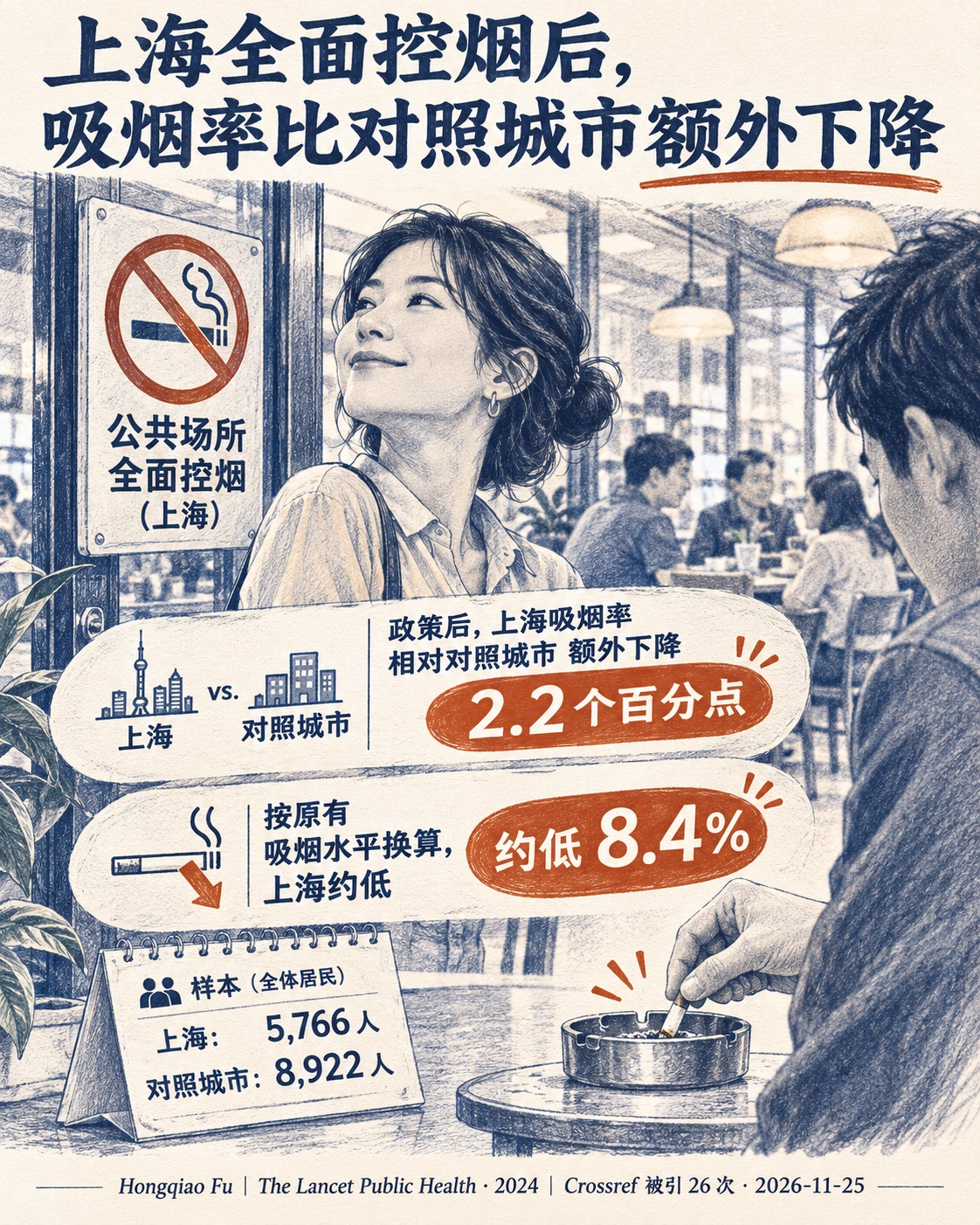
结果 共 14,688 名受访者,上海 5,766 人,对照城市 8,922 人。政策后上海吸烟率相对对照额外下降 2.2 个百分点(95% 置信区间 2.1 至 2.3),相当于现有吸烟人数减少约 8.4%。男性、教育程度较高者、未婚和较年轻者的估计效果更大。模型推算类似政策全国实施可使 2017 至 2035 年 GDP 增加 0.04% 至 0.07%。
结论 研究结果支持严格执行全面公共场所禁烟有助减少吸烟;作者的全国模型估计其经济收益可超过执行成本。
展开英文原摘要收起英文原摘要China has one of the highest levels of tobacco consumption globally, and there is no national smoke-free legislation. Although more than 20 Chinese cities have passed local smoke-free laws since 2008, evidence on their effectiveness in reducing smoking behaviours and their economic benefits is scarce. By exploiting a natural quasi-experiment, whereby a comprehensive public smoking ban was implemented in Shanghai in March, 2017, this study aims to assess the impact of the policy on individual smoking behaviours and quantify its effect on macroeconomic outcomes. In this difference-in-differences analysis and modelling study, we used data on smoking behaviours from the 2012, 2014, 2016, and 2018 waves of the China Family Panel Studies. We used a difference-in-differences approach to investigate trends in smoking prevalence in respondents in Shanghai, relative to respondents from other direct-administered municipalities, provincial capital cities, and subprovincial municipalities (control group), after the implementation of a smoking ban in 2017. All respondents aged 18 years or older were included, with the exception of people who lived in Beijing and rural areas. The primary variable of interest in the difference-in-differences analysis was self-reported smoking status. Based on the difference-in-differences estimation of reduction in smoking prevalence, we then used a health-augmented macroeconomic model to estimate the potential macroeconomic gains if such a ban was implemented across China for the period 2017-35. 14 688 respondents were included in the analysis: 5766 from Shanghai and 8922 from the control group. After the implementation of the smoking ban in Shanghai in 2017, smoking prevalence decreased by 2·2 percentage points (95% CI 2·1-2·3), equivalent to an 8·4% reduction in the number of current smokers. The smoking ban had a larger effect on men, people with a higher level of education, unmarried people, and younger people when compared with their respective counterparts. The modelling analysis showed that implementing a nationwide comprehensive public smoking ban similar to that in Shanghai would result in a 0·04-0·07% increase in the national gross domestic product in China between 2017 and 2035, outweighing the economic costs of smoking ban enforcement. The smoking ban in Shanghai shows that a comprehensive public smoking ban with strict enforcement is effective in curbing smoking behaviours. Moreover, the implementation of a comprehensive public smoking ban across China would be cost-effective. National Social Science Fund of China.
BACKGROUND · China has one of the highest levels of tobacco consumption globally, and there is no national smoke-free legislation. Although more than 20 Chinese cities have passed local smoke-free laws since 2008, evidence on their effectiveness in reducing smoking behaviours and their economic benefits is scarce. By exploiting a natural quasi-experiment, whereby a comprehensive public smoking ban was implemented in Shanghai in March, 2017, this study aims to assess the impact of the policy on individual smoking behaviours and quantify its effect on macroeconomic outcomes.
METHODS · In this difference-in-differences analysis and modelling study, we used data on smoking behaviours from the 2012, 2014, 2016, and 2018 waves of the China Family Panel Studies. We used a difference-in-differences approach to investigate trends in smoking prevalence in respondents in Shanghai, relative to respondents from other direct-administered municipalities, provincial capital cities, and subprovincial municipalities (control group), after the implementation of a smoking ban in 2017. All respondents aged 18 years or older were included, with the exception of people who lived in Beijing and rural areas. The primary variable of interest in the difference-in-differences analysis was self-reported smoking status. Based on the difference-in-differences estimation of reduction in smoking prevalence, we then used a health-augmented macroeconomic model to estimate the potential macroeconomic gains if such a ban was implemented across China for the period 2017-35.
FINDINGS · 14 688 respondents were included in the analysis: 5766 from Shanghai and 8922 from the control group. After the implementation of the smoking ban in Shanghai in 2017, smoking prevalence decreased by 2·2 percentage points (95% CI 2·1-2·3), equivalent to an 8·4% reduction in the number of current smokers. The smoking ban had a larger effect on men, people with a higher level of education, unmarried people, and younger people when compared with their respective counterparts. The modelling analysis showed that implementing a nationwide comprehensive public smoking ban similar to that in Shanghai would result in a 0·04-0·07% increase in the national gross domestic product in China between 2017 and 2035, outweighing the economic costs of smoking ban enforcement.
INTERPRETATION · The smoking ban in Shanghai shows that a comprehensive public smoking ban with strict enforcement is effective in curbing smoking behaviours. Moreover, the implementation of a comprehensive public smoking ban across China would be cost-effective.
FUNDING · National Social Science Fund of China.
Hongqiao Fu, Sian Tsuei, Yunting Zheng, Simiao Chen, Shirui Zhu, Duo Xu, Winnie Yip
Copyright © 2024 The Author(s). Published by Elsevier Ltd. This is an Open Access article under the CC BY 4.0 license. Published by Elsevier Ltd.. All rights reserved.
上海实施后
| 上海实施后 | 估计结果 |
|---|---|
| 吸烟率相对其他城市变化 | 下降 2.2 个百分点 |
| 按原有吸烟水平换算 | 约减少 8.4% |
作者的结论
研究结果支持严格执行全面公共场所禁烟有助减少吸烟;作者的全国模型估计其经济收益可超过执行成本。
研究团队与论文影响
Hongqiao Fu 等在《The Lancet Public Health》发表这项研究。论文署名单位包括北京大学、加拿大不列颠哥伦比亚大学。
Crossref 收录本文引用 26 次。
单篇与期刊指标核查于 。
原文与延伸阅读
引用这篇文章与反馈纠错
研象编辑部.上海全面控烟后,吸烟率比对照城市额外下降[EB/OL].研象,2026-11-25.https://yanxiang.hk/papers/shanghai-smoke-free-policy
发现数字、译文或出处有误,可以在邮件里指出相应段落,附上核对依据。