
英格兰家庭从饮料买回的糖少了,模型预计十年里儿童超重或肥胖也会减少
PLOS Medicine2024人群负担估计Crossref 记录被引 44 次
一张购物小票,能告诉我们十年后的儿童健康吗?
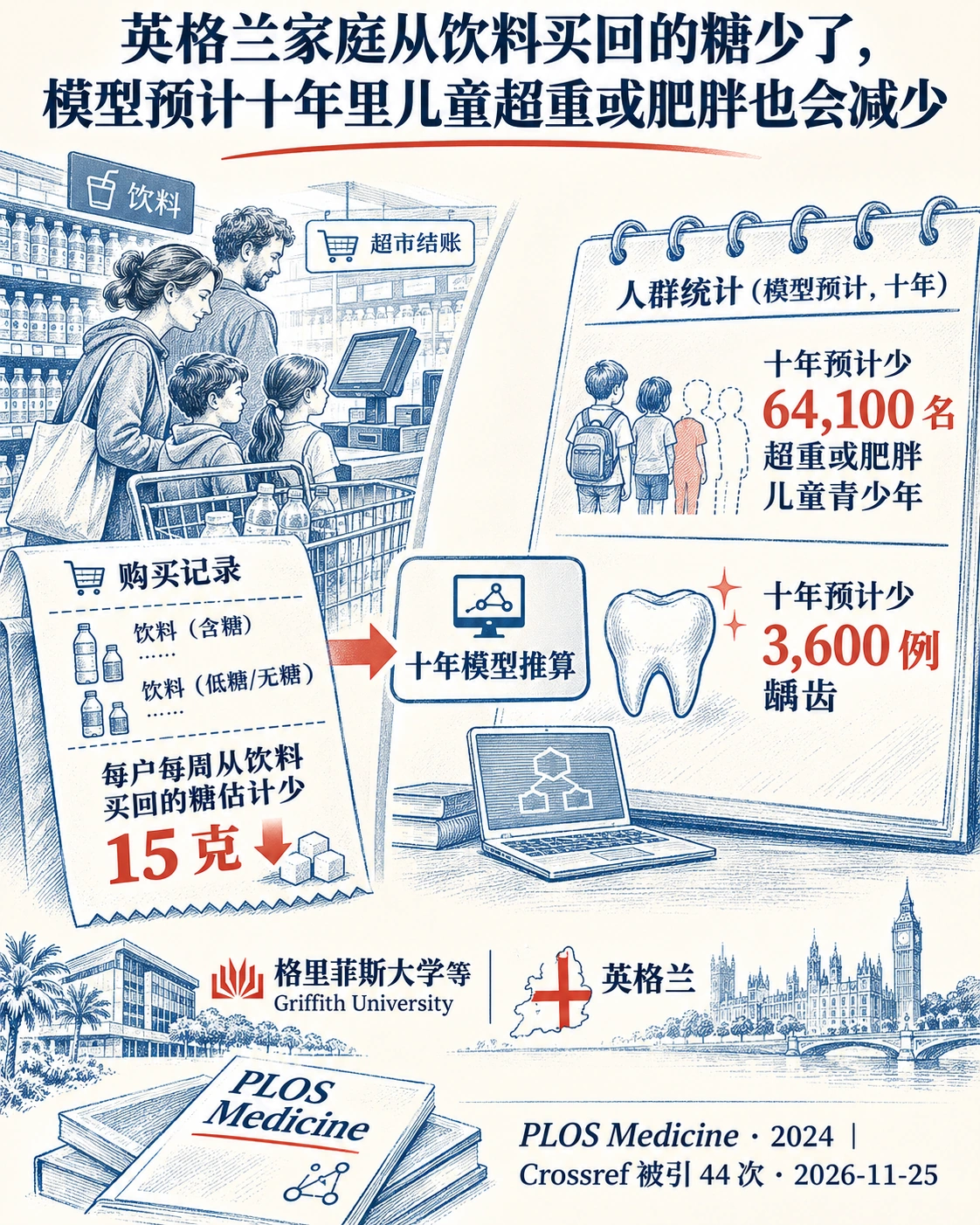
英国软饮料行业税实施后,英格兰家庭每周从饮料买回的糖估计少了 15 克。把购糖变化输入模型,作者预计十年内可少约 6.41 万名超重或肥胖儿童青少年,并减少约 3,600 例龋齿。
推荐阅读的理由
买回多少糖可以从购买记录估算,十年后出现多少龋齿或超重还需要另一步。作者用观察到的购糖变化和已有的糖摄入与健康关系建立模型。这样可以预先比较哪些社区可能获益最大,也让读者知道哪些数字要等长期观察才能验证。
Impact of the UK soft drinks industry levy on health and health inequalities in children and adolescents in England: An interrupted time series analysis and population health modelling study
作者摘要 · 中文编译
背景 英国软饮料行业税实施后,家庭从饮料买回的糖减少。研究估算这种变化对英格兰儿童青少年健康及健康不平等的中、长期潜在影响。
设计 研究按地区多重贫困指数五等分,用带对照的中断时间序列分析实施后 19 个月每户每周购糖变化。根据观察到的减少量,估算 0 至 17 岁人群的体重指数、龋齿与质量调整生命年变化,并以生命表模拟当前出生队列的长远预期寿命。用不平等斜率指数比较贫富地区差距。
结果 英格兰每户每周从购买饮料获得的糖估计减少 15 克(95% 置信区间,减少 10.3 至 19.7 克)。模型预计实施后十年少 3,600 例龋齿(95% 不确定区间 946 至 6,330),少 64,100 名超重或肥胖儿童青少年(54,400 至 73,400)。最贫困及次贫困地区预计增加的质量调整生命年分别为 11,000(8,370 至 14,100)和 7,760(5,730 至 9,970);其余三等分依次为 −1,830(−3,260 至 −501)、652(−336 至 1,680)、1,860(929 至 2,890)。如果这些变化终身维持,模型预计女性预期寿命不平等斜率指数减少 0.76%(降幅 0.62% 至 0.90%),男性减少 0.94%(0.76% 至 1.1%)。
结论 作者预测这项税制中期可减少龋齿及超重或肥胖,长期可提高预期寿命;较贫困地区的孩子获益最多,因此有可能缩小健康差距。
展开英文原摘要收起英文原摘要The soft drinks industry levy (SDIL) in the United Kingdom has led to a significant reduction in household purchasing of sugar in drinks. In this study, we examined the potential medium- and long-term implications for health and health inequalities among children and adolescents in England. We conducted a controlled interrupted time series analysis to measure the effects of the SDIL on the amount of sugar per household per week from soft drinks purchased, 19 months post implementation and by index of multiple deprivation (IMD) quintile in England. We modelled the effect of observed sugar reduction on body mass index (BMI), dental caries, and quality-adjusted life years (QALYs) in children and adolescents (0 to 17 years) by IMD quintile over the first 10 years following announcement (March 2016) and implementation (April 2018) of the SDIL. Using a lifetable model, we simulated the potential long-term impact of these changes on life expectancy for the current birth cohort and, using regression models with results from the IMD-specific lifetable models, we calculated the impact of the SDIL on the slope index of inequality (SII) in life expectancy. The SDIL was found to have reduced sugar from purchased drinks in England by 15 g/household/week (95% confidence interval: −10.3 to −19.7). The model predicts these reductions in sugar will lead to 3,600 (95% uncertainty interval: 946 to 6,330) fewer dental caries and 64,100 (54,400 to 73,400) fewer children and adolescents classified as overweight or obese, in the first 10 years after implementation. The changes in sugar purchasing and predicted impacts on health are largest for children and adolescents in the most deprived areas (Q1: 11,000 QALYs [8,370 to 14,100] and Q2: 7,760 QALYs [5,730 to 9,970]), while children and adolescents in less deprived areas will likely experience much smaller simulated effects (Q3: −1,830 QALYs [−3,260 to −501], Q4: 652 QALYs [−336 to 1,680], Q5: 1,860 QALYs [929 to 2,890]). If the simulated effects of the SDIL are sustained over the life course, it is predicted there will be a small but significant reduction in slope index of inequality: 0.76% (95% uncertainty interval: −0.9 to −0.62) for females and 0.94% (−1.1 to −0.76) for males. We predict that the SDIL will lead to medium-term reductions in dental caries and overweight/obesity, and long-term improvements in life expectancy, with the greatest benefits projected for children and adolescents from more deprived areas. This study provides evidence that the SDIL could narrow health inequalities for children and adolescents in England.
Background · The soft drinks industry levy (SDIL) in the United Kingdom has led to a significant reduction in household purchasing of sugar in drinks. In this study, we examined the potential medium- and long-term implications for health and health inequalities among children and adolescents in England.
Methods and findings · We conducted a controlled interrupted time series analysis to measure the effects of the SDIL on the amount of sugar per household per week from soft drinks purchased, 19 months post implementation and by index of multiple deprivation (IMD) quintile in England. We modelled the effect of observed sugar reduction on body mass index (BMI), dental caries, and quality-adjusted life years (QALYs) in children and adolescents (0 to 17 years) by IMD quintile over the first 10 years following announcement (March 2016) and implementation (April 2018) of the SDIL. Using a lifetable model, we simulated the potential long-term impact of these changes on life expectancy for the current birth cohort and, using regression models with results from the IMD-specific lifetable models, we calculated the impact of the SDIL on the slope index of inequality (SII) in life expectancy. The SDIL was found to have reduced sugar from purchased drinks in England by 15 g/household/week (95% confidence interval: −10.3 to −19.7). The model predicts these reductions in sugar will lead to 3,600 (95% uncertainty interval: 946 to 6,330) fewer dental caries and 64,100 (54,400 to 73,400) fewer children and adolescents classified as overweight or obese, in the first 10 years after implementation. The changes in sugar purchasing and predicted impacts on health are largest for children and adolescents in the most deprived areas (Q1: 11,000 QALYs [8,370 to 14,100] and Q2: 7,760 QALYs [5,730 to 9,970]), while children and adolescents in less deprived areas will likely experience much smaller simulated effects (Q3: −1,830 QALYs [−3,260 to −501], Q4: 652 QALYs [−336 to 1,680], Q5: 1,860 QALYs [929 to 2,890]). If the simulated effects of the SDIL are sustained over the life course, it is predicted there will be a small but significant reduction in slope index of inequality: 0.76% (95% uncertainty interval: −0.9 to −0.62) for females and 0.94% (−1.1 to −0.76) for males.
Conclusions · We predict that the SDIL will lead to medium-term reductions in dental caries and overweight/obesity, and long-term improvements in life expectancy, with the greatest benefits projected for children and adolescents from more deprived areas. This study provides evidence that the SDIL could narrow health inequalities for children and adolescents in England.
Linda J Cobiac, Nina T Rogers, Jean Adams, Steven Cummins, Richard Smith, Oliver Mytton, Martin White, Peter Scarborough
© 2024 Cobiac et al
哪些数字来自购买资料,哪些来自预测?
| 项目 | 估计值和区间 |
|---|---|
| 每户每周从饮料买回的糖 | 少 15 克(95% 置信区间,少 10.3 至 19.7 克) |
| 十年内超重或肥胖儿童青少年人数 | 预计少 64,100 人(95% 不确定区间 54,400 至 73,400) |
| 十年内龋齿 | 预计少 3,600 例(946 至 6,330) |
健康预测针对英格兰 0 至 17 岁人群,原文表 2 按地区贫困程度列出了结果。 核对作者图表
作者的结论
作者预计,饮料税带来的购糖变化可在中期减少龋齿和超重或肥胖,并可能改善长期预期寿命。模型中,较贫困地区儿童青少年获得的健康收益最大。
研究团队与论文影响
格里菲斯大学等研究团队采用英格兰家庭购买数据和按社区贫困程度分层的生命表模型。论文发表于 PLOS Medicine,区分了税后 19 个月的购买估计与十年或更长期的预测。
Crossref 收录本文引用 44 次。
单篇与期刊指标核查于 。
原文与延伸阅读
引用这篇文章与反馈纠错
研象编辑部.英格兰家庭从饮料买回的糖少了,模型预计十年里儿童超重或肥胖也会减少[EB/OL].研象,2026-11-25.https://yanxiang.hk/papers/uk-drink-levy-child-health-model
发现数字、译文或出处有误,可以在邮件里指出相应段落,附上核对依据。