
美国推进退伍军人安置计划期间,统计到的无家可归退伍军人人数下降逾半
JAMA Network Open2024政策实施评估Crossref 记录被引 20 次
一把房门钥匙交出去之后,谁继续负责?
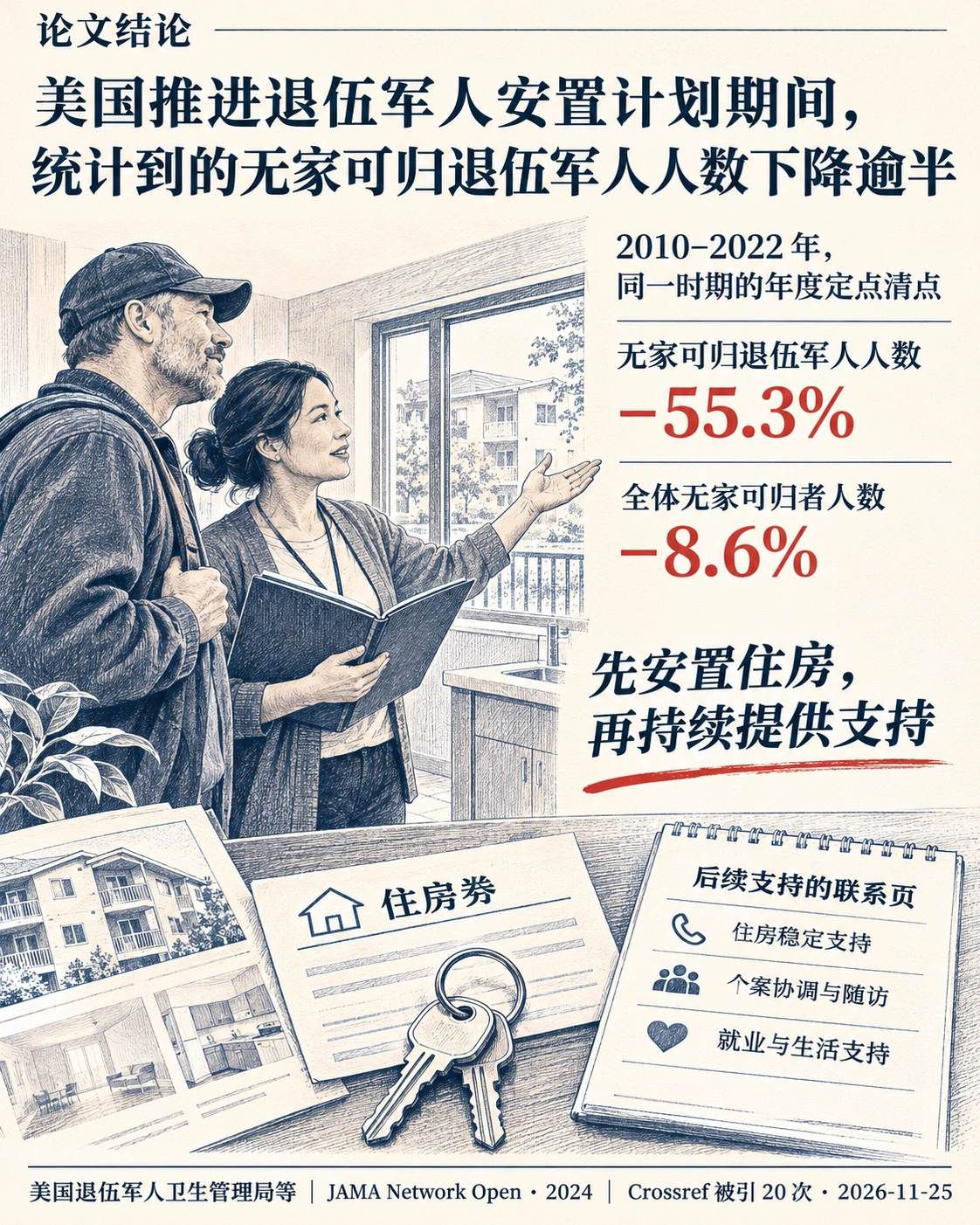
2010 至 2022 年,美国点时清点所记录的无家可归退伍军人人数减少 55.3%,同期全体无家可归者人数减少 8.6%。这期间,退伍军人服务系统把先提供住所、再给持续支持作为工作方针。
推荐阅读的理由
住房券可以解决一部分房租,社区机构可以帮助找房,医疗和社会服务团队可以在入住后持续联系。论文把这些具体做法和全国每年同一时点的清点放在一起,还访谈了负责实施的管理者。这让读者既能看见人数变化,也能看见安置怎样落实。
Changes in Homelessness Among US Veterans After Implementation of the Ending Veteran Homelessness Initiative
作者摘要 · 中文编译
背景与目的 无家可归是长期存在的问题,卫生系统在整体应对中应承担什么角色仍不明确。研究比较美国联邦退伍军人安置倡议实施前后,退伍军人及总体人群的无家可归状况。
设计与措施 这项全国性回顾队列研究结合定量与定性方法,使用 2007 至 2022 年行政及人口数据。2007 至 2009 年为实施前,2010 至 2022 年为实施期。退伍军人卫生管理局项目提供住房、个案管理及综合临床和社会支持。研究考察全国点时清点、住房券、对社区机构的拨款和每年获安置人数,并以半结构访谈了解政策如何执行。
结果 2022 年点时清点记录到 33,129 名无家可归的退伍军人,其中 88.7% 为男性,40.9% 露宿在缺乏庇护的场所。倡议实施期间,退伍军人无家可归人数下降 55.3%,总体人群下降 8.6%;退伍军人在所有无家可归者中的占比从 11.6% 降至 5.3%。这一变化伴随该机构改采住房优先政策、降低获取住房的门槛,以及住房券、社区合作拨款和入住后临床及社会支持服务的扩充。访谈对象反复提到住房优先、社区合作与实时数据的重要性。
结论 倡议实施后,退伍军人无家可归人数的降幅明显大于总体人群。作者认为,卫生系统在处理影响健康的复杂社会因素方面具有重要作用。部分条件是退伍军人体系特有的,其他卫生系统仍可借鉴其中的做法。
展开英文原摘要收起英文原摘要Homelessness is a persistent and growing problem. What role health systems should play and how that role is incorporated into larger strategic efforts are not well-defined. To compare homelessness among veterans with that in the general population during a 16-year study period before and after implementation of the Ending Veteran Homelessness Initiative, a program to rehouse veterans experiencing homelessness. This national retrospective cohort study using a mixed-methods approach examined annualized administrative (January 1, 2007, to December 31, 2022) and population data prior to (2007-2009) and during (2010-2022) the Ending Veteran Homelessness initiative. Participants included unhoused adults in the US between 2007 and 2022. Enrollment in Veterans Health Administration (VHA) Homeless Program Office components providing housing, case management, and wrap-around clinical and supportive services. Point-in-time (PIT) count data for unhoused veterans and nonveterans during the study period, number of Section 8 housing vouchers provided by Housing and Urban Development–Veterans Administration Supportive Housing, number of community grants awarded by Supportive Services for Veterans and Families, and total number of veterans housed each year. Semistructured interviews with VHA leadership were performed to gain insight into the strategy. In 2022, 33 129 veterans were identified in the PIT count. They were predominantly male (88.7%), and 40.9% were unsheltered. During the active years of the Ending Veteran Homelessness initiative, veteran homelessness decreased 55.3% compared with 8.6% for the general population. The proportion of veterans in this cohort also declined from 11.6% to 5.3%. This change occurred during a shift to “housing first” as agency policy to create low-barrier housing availability. It was also coupled with substantial growth in housing vouchers, grants to community partner agencies, and growth in VHA clinical and social programming to provide homeless-tailored wrap-around services and support once participants were housed. Key respondent interviews consistently cited the shift to housing first, the engagement with community partners, and use of real-time data as critical. In this cohort study of the federal Ending Veteran Homelessness initiative, after program implementation, there was a substantially greater decrease in homelessness among veterans than in the general population. These findings suggest an important role for health systems in addressing complex social determinants of health. While some conditions unique to the VHA facilitated the change in homelessness, lessons learned here are applicable to other health systems.
Importance · Homelessness is a persistent and growing problem. What role health systems should play and how that role is incorporated into larger strategic efforts are not well-defined.
Objective · To compare homelessness among veterans with that in the general population during a 16-year study period before and after implementation of the Ending Veteran Homelessness Initiative, a program to rehouse veterans experiencing homelessness.
Design, Setting, and Participants · This national retrospective cohort study using a mixed-methods approach examined annualized administrative (January 1, 2007, to December 31, 2022) and population data prior to (2007-2009) and during (2010-2022) the Ending Veteran Homelessness initiative. Participants included unhoused adults in the US between 2007 and 2022.
Exposure · Enrollment in Veterans Health Administration (VHA) Homeless Program Office components providing housing, case management, and wrap-around clinical and supportive services.
Main Outcomes and Measures · Point-in-time (PIT) count data for unhoused veterans and nonveterans during the study period, number of Section 8 housing vouchers provided by Housing and Urban Development–Veterans Administration Supportive Housing, number of community grants awarded by Supportive Services for Veterans and Families, and total number of veterans housed each year. Semistructured interviews with VHA leadership were performed to gain insight into the strategy.
Results · In 2022, 33 129 veterans were identified in the PIT count. They were predominantly male (88.7%), and 40.9% were unsheltered. During the active years of the Ending Veteran Homelessness initiative, veteran homelessness decreased 55.3% compared with 8.6% for the general population. The proportion of veterans in this cohort also declined from 11.6% to 5.3%. This change occurred during a shift to “housing first” as agency policy to create low-barrier housing availability. It was also coupled with substantial growth in housing vouchers, grants to community partner agencies, and growth in VHA clinical and social programming to provide homeless-tailored wrap-around services and support once participants were housed. Key respondent interviews consistently cited the shift to housing first, the engagement with community partners, and use of real-time data as critical.
Conclusions and Relevance · In this cohort study of the federal Ending Veteran Homelessness initiative, after program implementation, there was a substantially greater decrease in homelessness among veterans than in the general population. These findings suggest an important role for health systems in addressing complex social determinants of health. While some conditions unique to the VHA facilitated the change in homelessness, lessons learned here are applicable to other health systems.
Thomas P O'Toole, Lisa M Pape, Vincent Kane, Monica Diaz, Anne Dunn, James L Rudolph, Shereef Elnahal
Copyright 2024 O’Toole TP et al. JAMA Network Open.
全国点时清点的三个读数
| 指标 | 结果 |
|---|---|
| 退伍军人无家可归人数,2010 至 2022 年 | 下降 55.3% |
| 全部无家可归人数,同期 | 下降 8.6% |
| 退伍军人占全部无家可归者的比例 | 由 11.6% 降至 5.3% |
2022 年清点到 33,129 名无家可归的退伍军人。对照的是各年度同一统计口径的人数,并非逐人随访结果。 核对作者图表
作者的结论
作者认为,联邦安置计划实施后,退伍军人无家可归人数的降幅大于总体人群,卫生系统有可能参与解决居住不稳这类复杂问题。投入、住房政策和服务同时改变,研究无法单独估出每一项的作用。
研究团队与论文影响
美国退伍军人卫生管理局和布朗大学等合作。研究使用 16 年行政与人口资料,并访谈参与实施的卫生管理人员,对照全国住房券、社区拨款和安置记录。
Crossref 收录本文引用 20 次。JAMA Network Open 在 2025 年度回顾中列出的期刊影响因子为 9.7。
单篇与期刊指标核查于 。
原文与延伸阅读
引用这篇文章与反馈纠错
研象编辑部.美国推进退伍军人安置计划期间,统计到的无家可归退伍军人人数下降逾半[EB/OL].研象,2026-11-25.https://yanxiang.hk/papers/veterans-homelessness-housing-first
发现数字、译文或出处有误,可以在邮件里指出相应段落,附上核对依据。