
威尔士自然实验发现,接种带状疱疹疫苗后,七年内新诊断痴呆的概率较低
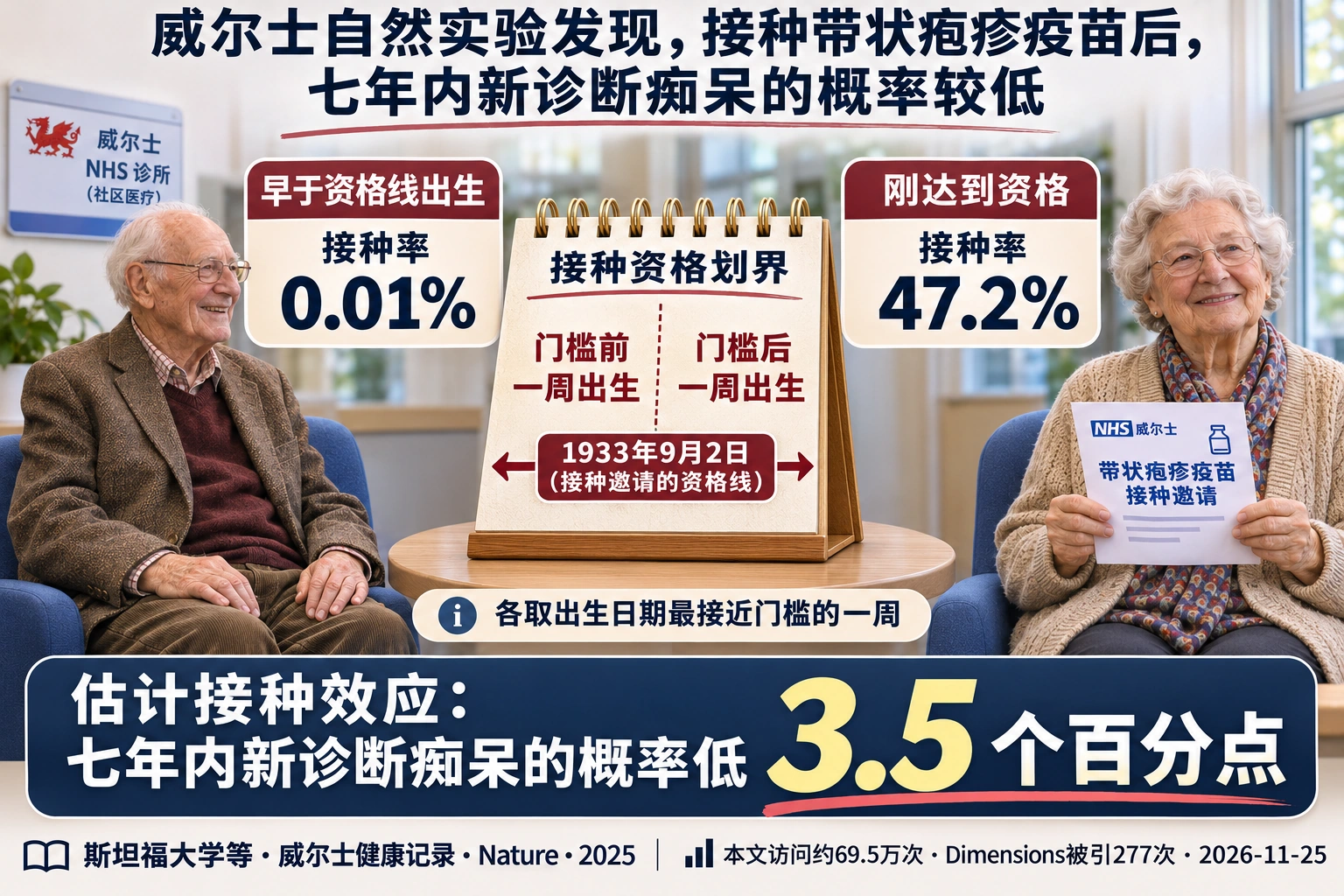
只差几天的生日,为什么能帮助判断疫苗的效果?
威尔士的疫苗资格按出生日期划线。研究者比较生日紧邻界线的人,估计接种减毒活带状疱疹疫苗后,七年内新诊断痴呆的概率低 3.5 个百分点。
推荐阅读的理由
如果直接比较自愿接种和未接种的人,看病习惯本来就可能不同。这项研究找到一个由政策造成的分界:比门槛老不到一周的人几乎没人接种,刚好够资格的一周却有近一半人接种。作者利用这个突变估算接种的效果。读图时可以先看生日如何改变接种机会,再看七年后的诊断。
A natural experiment on the effect of herpes zoster vaccination on dementia
作者摘要 · 中文编译
背景 可能影响神经系统的疱疹病毒与痴呆发生有关,疫苗也可能产生针对目标疾病以外的免疫作用。研究想了解接种带状疱疹减毒活疫苗会怎样影响痴呆诊断。
方法 为获得更接近因果解释的证据,作者利用威尔士按确切出生日期规定接种资格的政策。1933 年 9 月 2 日前出生的人终身不符合资格,当天或以后出生的人至少有一年符合资格。
结果 大型电子健康记录显示,比资格线老不到一周者中仅 0.01% 接种,刚刚够资格的一周内出生者中有 47.2% 接种。除接种机会外,两组人不太可能存在系统性差别。用回归不连续设计比较后,作者估计接种使七年内新诊断痴呆的概率降低 3.5 个百分点(95% 置信区间 0.6 至 7.1,P=0.019),相对减少 20.0%(6.5% 至 33.4%)。女性的这一保护效应更强。
独立验证与结论 作者又研究了英格兰与威尔士的合并人群,用死亡证明考察以痴呆为主要死因的死亡。这一结局较少依赖患者能否及时获诊,也印证了主要发现。这项自然实验为疫苗可能预防或延缓痴呆提供了证据,受到混杂和偏倚的影响比以往单纯比较接种者与未接种者的研究小。
展开英文原摘要收起英文原摘要Neurotropic herpesviruses may be implicated in the development of dementia1–5. Moreover, vaccines may have important off-target immunological effects6–9. Here we aim to determine the effect of live-attenuated herpes zoster vaccination on the occurrence of dementia diagnoses. To provide causal as opposed to correlational evidence, we take advantage of the fact that, in Wales, eligibility for the zoster vaccine was determined on the basis of an individual’s exact date of birth. Those born before 2 September 1933 were ineligible and remained ineligible for life, whereas those born on or after 2 September 1933 were eligible for at least 1 year to receive the vaccine. Using large-scale electronic health record data, we first show that the percentage of adults who received the vaccine increased from 0.01% among patients who were merely 1 week too old to be eligible, to 47.2% among those who were just 1 week younger. Apart from this large difference in the probability of ever receiving the zoster vaccine, individuals born just 1 week before 2 September 1933 are unlikely to differ systematically from those born 1 week later. Using these comparison groups in a regression discontinuity design, we show that receiving the zoster vaccine reduced the probability of a new dementia diagnosis over a follow-up period of 7 years by 3.5 percentage points (95% confidence interval (CI) = 0.6–7.1, P = 0.019), corresponding to a 20.0% (95% CI = 6.5–33.4) relative reduction. This protective effect was stronger among women than men. We successfully confirm our findings in a different population (England and Wales’s combined population), with a different type of data (death certificates) and using an outcome (deaths with dementia as primary cause) that is closely related to dementia, but less reliant on a timely diagnosis of dementia by the healthcare system10. Through the use of a unique natural experiment, this study provides evidence of a dementia-preventing or dementia-delaying effect from zoster vaccination that is less vulnerable to confounding and bias than the existing associational evidence.
Neurotropic herpesviruses may be implicated in the development of dementia1–5. Moreover, vaccines may have important off-target immunological effects6–9. Here we aim to determine the effect of live-attenuated herpes zoster vaccination on the occurrence of dementia diagnoses. To provide causal as opposed to correlational evidence, we take advantage of the fact that, in Wales, eligibility for the zoster vaccine was determined on the basis of an individual’s exact date of birth. Those born before 2 September 1933 were ineligible and remained ineligible for life, whereas those born on or after 2 September 1933 were eligible for at least 1 year to receive the vaccine. Using large-scale electronic health record data, we first show that the percentage of adults who received the vaccine increased from 0.01% among patients who were merely 1 week too old to be eligible, to 47.2% among those who were just 1 week younger. Apart from this large difference in the probability of ever receiving the zoster vaccine, individuals born just 1 week before 2 September 1933 are unlikely to differ systematically from those born 1 week later. Using these comparison groups in a regression discontinuity design, we show that receiving the zoster vaccine reduced the probability of a new dementia diagnosis over a follow-up period of 7 years by 3.5 percentage points (95% confidence interval (CI) = 0.6–7.1, P = 0.019), corresponding to a 20.0% (95% CI = 6.5–33.4) relative reduction. This protective effect was stronger among women than men. We successfully confirm our findings in a different population (England and Wales’s combined population), with a different type of data (death certificates) and using an outcome (deaths with dementia as primary cause) that is closely related to dementia, but less reliant on a timely diagnosis of dementia by the healthcare system10. Through the use of a unique natural experiment, this study provides evidence of a dementia-preventing or dementia-delaying effect from zoster vaccination that is less vulnerable to confounding and bias than the existing associational evidence.
Markus Eyting, Min Xie, Felix Michalik, Simon Heß, Seunghun Chung, Pascal Geldsetzer
© The Author(s) 2025
谁能接种,七年后发生了什么?
| 问题 | 研究结果 |
|---|---|
| 比资格线老不到一周者实际接种 | 0.01% |
| 刚好符合资格的一周内出生者实际接种 | 47.2% |
| 接种对七年内新诊断痴呆概率的估计 | 低 3.5 个百分点(95% 置信区间低 0.6 至 7.1 个百分点) |
| 换算成相对差异 | 低 20.0%(95% 置信区间低 6.5% 至 33.4%) |
前两行是观察到的接种比例。后两行是出生日期门槛附近人群的效应估计,同一个结果分别用绝对量和相对量表达。 核对作者图表
作者的结论
作者认为,在威尔士这一代接近 80 岁的人中,接种带状疱疹减毒活疫苗可能预防或延缓痴呆。研究记录的是医疗系统何时作出诊断。作者用死亡证明作另一次分析,也得到支持这一解释的结果。
研究团队与论文影响
斯坦福大学 Pascal Geldsetzer 等利用威尔士长期医疗记录研究疫苗接种政策,又用英格兰和威尔士的死亡证明作验证。这一设计的价值在于,同一种政策给出生日期非常接近的人带来了截然不同的接种机会。
出版商统计本文访问约 69.5 万次,Dimensions 收录引用 277 次。Nature 的 2025 年期刊影响因子为 56.1。
单篇与期刊指标核查于 。
原文与延伸阅读
引用这篇文章与反馈纠错
研象编辑部.威尔士自然实验发现,接种带状疱疹疫苗后,七年内新诊断痴呆的概率较低[EB/OL].研象,2026-11-25.https://yanxiang.hk/papers/wales-zoster-dementia
发现数字、译文或出处有误,可以在邮件里指出相应段落,附上核对依据。