
儿童腕部隆起骨折,提供软绷带与硬固定的第三天疼痛相当
The Lancet2022随机对照试验Crossref 记录被引 66 次
儿童腕部隆起骨折,软绷带与硬固定的第三天疼痛是否相当?
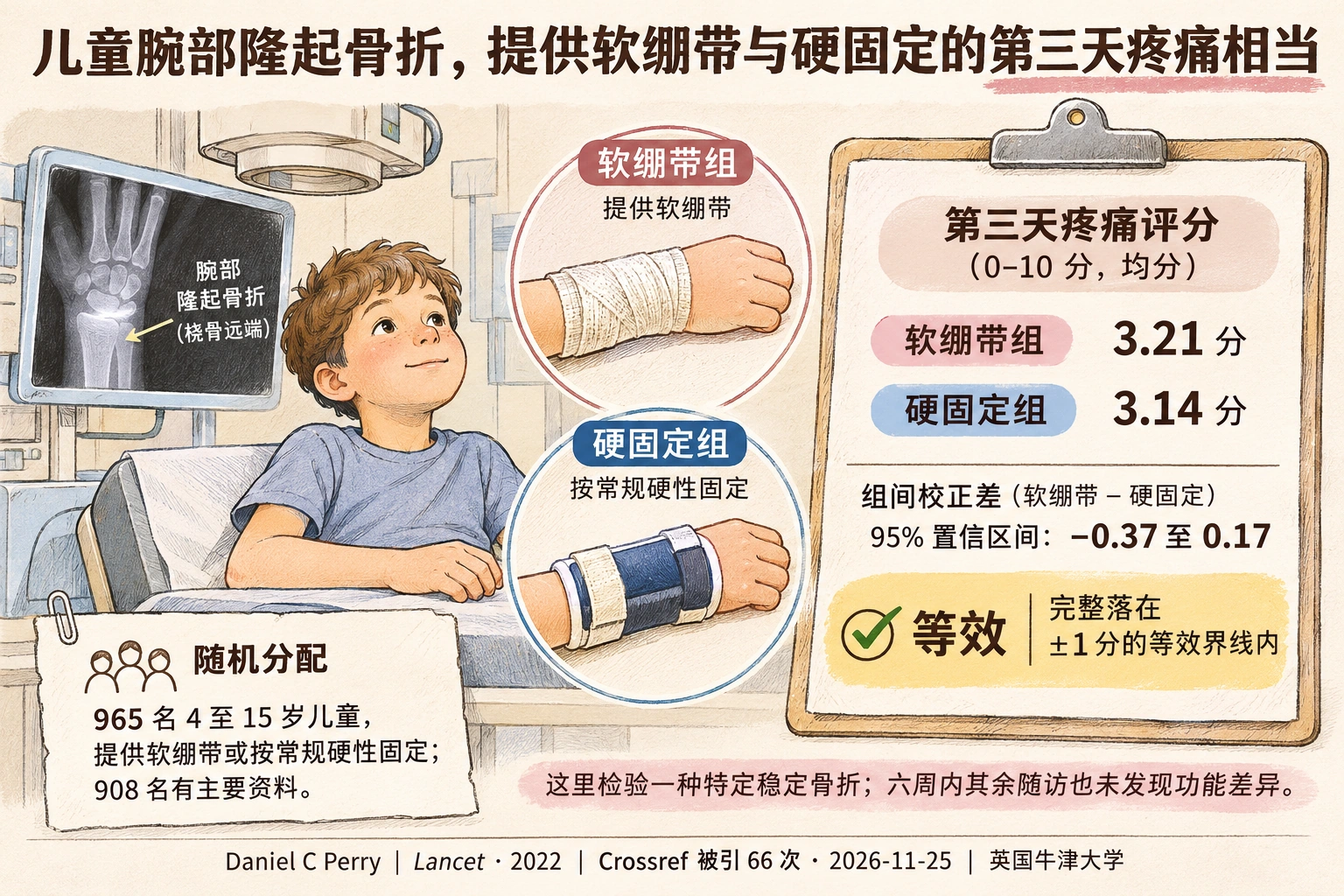
对这类桡骨远端隆起骨折的儿童,提供软绷带和硬性固定在第三天疼痛方面等效,六周随访期的功能结果亦相近。
推荐阅读的理由
研究对象是一种特定的稳定性骨折。作者预先定义多大疼痛差距可以接受,才能有根据地说两种处理效果相当。
Immobilisation of torus fractures of the wrist in children (FORCE): a randomised controlled equivalence trial in the UK
作者摘要 · 中文编译
背景 儿童桡骨远端隆起骨折常见,各地有简单包扎后回家和硬性固定并复诊等不同处理。
方法 英国 23 家医院将 965 名 4 至 15 岁儿童随机分至提供软绷带后出院或按医院常规硬固定、随访。主要终点为第三天面部表情量表疼痛得分,等效界值预设为一分。
结果 908 人有主要结果。第三天平均疼痛分别为 3.21 和 3.14 分,调整后差 −0.10 分(95% 置信区间 −0.37 至 0.17),整个区间落入等效界值内。按方案分析结果相似,六周内疼痛及功能也未见组间差异。
结论 对这类桡骨远端隆起骨折的儿童,提供软绷带和硬性固定在第三天疼痛方面等效,六周随访期的功能结果亦相近。
展开英文原摘要收起英文原摘要The most common fractures in children are torus (buckle) fractures of the wrist. Controversy exists over treatment, which ranges from splint immobilisation and discharge to cast immobilisation, follow-up, and repeat imaging. This study compared pain and function in affected children offered a soft bandage and immediate discharge with those receiving rigid immobilisation and follow-up as per treating centre protocol. In this randomised controlled equivalence trial we included 965 children (aged 4-15 years) with a distal radius torus fracture from 23 hospitals in the UK. Children were randomly allocated in a 1:1 ratio to the offer of bandage group or rigid immobilisation group using bespoke web-based randomisation software. Treating clinicians, participants, and their families could not be masked to treatment allocation. Exclusion criteria included multiple injuries, diagnosis at more than 36 h after injury, and inability to complete follow-up. The primary outcome was pain at 3-days post-randomisation measured using Wong-Baker FACES Pain Rating Scale. We performed a modified intention-to-treat and per protocol analysis. The trial was registered with ISRCTN registry, ISRCTN13955395. Between Jan 16, 2019, and July 13, 2020, 965 children were randomly allocated to a group, 489 to the offer of a bandage group and 476 to the rigid immobilisation group, 379 (39%) were girls and 586 (61%) were boys. Primary outcome data was collected for 908 (94%) of participants, all of whom were included in the modified intention-to-treat analysis. Pain was equivalent at 3 days with 3·21 points (SD 2·08) in the offer of bandage group versus 3·14 points (2·11) in the rigid immobilisation group. With reference to a prespecified equivalence margin of 1·0, the adjusted difference in the intention-to-treat population was -0·10 (95% CI -0·37 to 0·17) and-0·06 (95% CI -0·34 to 0·21) in the per-protocol population. This trial found equivalence in pain at 3 days in children with a torus fracture of the distal radius assigned to the offer of a bandage group or the rigid immobilisation group, with no between-group differences in pain or function during the 6 weeks of follow-up. UK National Institute for Health and Care Research.
BACKGROUND · The most common fractures in children are torus (buckle) fractures of the wrist. Controversy exists over treatment, which ranges from splint immobilisation and discharge to cast immobilisation, follow-up, and repeat imaging. This study compared pain and function in affected children offered a soft bandage and immediate discharge with those receiving rigid immobilisation and follow-up as per treating centre protocol.
METHODS · In this randomised controlled equivalence trial we included 965 children (aged 4-15 years) with a distal radius torus fracture from 23 hospitals in the UK. Children were randomly allocated in a 1:1 ratio to the offer of bandage group or rigid immobilisation group using bespoke web-based randomisation software. Treating clinicians, participants, and their families could not be masked to treatment allocation. Exclusion criteria included multiple injuries, diagnosis at more than 36 h after injury, and inability to complete follow-up. The primary outcome was pain at 3-days post-randomisation measured using Wong-Baker FACES Pain Rating Scale. We performed a modified intention-to-treat and per protocol analysis. The trial was registered with ISRCTN registry, ISRCTN13955395.
FINDINGS · Between Jan 16, 2019, and July 13, 2020, 965 children were randomly allocated to a group, 489 to the offer of a bandage group and 476 to the rigid immobilisation group, 379 (39%) were girls and 586 (61%) were boys. Primary outcome data was collected for 908 (94%) of participants, all of whom were included in the modified intention-to-treat analysis. Pain was equivalent at 3 days with 3·21 points (SD 2·08) in the offer of bandage group versus 3·14 points (2·11) in the rigid immobilisation group. With reference to a prespecified equivalence margin of 1·0, the adjusted difference in the intention-to-treat population was -0·10 (95% CI -0·37 to 0·17) and-0·06 (95% CI -0·34 to 0·21) in the per-protocol population.
INTERPRETATION · This trial found equivalence in pain at 3 days in children with a torus fracture of the distal radius assigned to the offer of a bandage group or the rigid immobilisation group, with no between-group differences in pain or function during the 6 weeks of follow-up.
FUNDING · UK National Institute for Health and Care Research.
Daniel C Perry, Juul Achten, Ruth Knight, Duncan Appelbe, Susan J Dutton, Melina Dritsaki, James M Mason, Damian T Roland, Shrouk Messahel, James Widnall, Matthew L Costa, FORCE Collaborators in collaboration with PERUKI
Copyright © 2022 The Author(s). Published by Elsevier Ltd. This is an Open Access article under the CC BY 4.0 license. Published by Elsevier Ltd.. All rights reserved.
第三天观察
| 第三天观察 | 疼痛评分 |
|---|---|
| 软绷带组平均值 | 3.21 分 |
| 硬固定组平均值 | 3.14 分 |
| 调整后的组间差 | −0.10 分(95% 置信区间 −0.37 至 0.17 分) |
| 试验预设的等效范围 | −1 至 1 分 |
作者的结论
对这类桡骨远端隆起骨折的儿童,提供软绷带和硬性固定在第三天疼痛方面等效,六周随访期的功能结果亦相近。
研究团队与论文影响
Daniel C Perry 等在《The Lancet》发表这项研究。论文署名单位包括英国牛津大学。
Crossref 收录本文引用 66 次。
单篇与期刊指标核查于 。
原文与延伸阅读
查阅这篇论文的期刊更正记录
引用这篇文章与反馈纠错
研象编辑部.儿童腕部隆起骨折,提供软绷带与硬固定的第三天疼痛相当[EB/OL].研象,2026-11-26.https://yanxiang.hk/papers/wrist-force
发现数字、译文或出处有误,可以在邮件里指出相应段落,附上核对依据。