
宫颈上皮内瘤变二级先观察或立即切除,后续妊娠的总体早产风险相近
JAMA Network Open2024队列研究Crossref 记录被引 19 次
“先观察的人”里面,后来走了哪两条路?
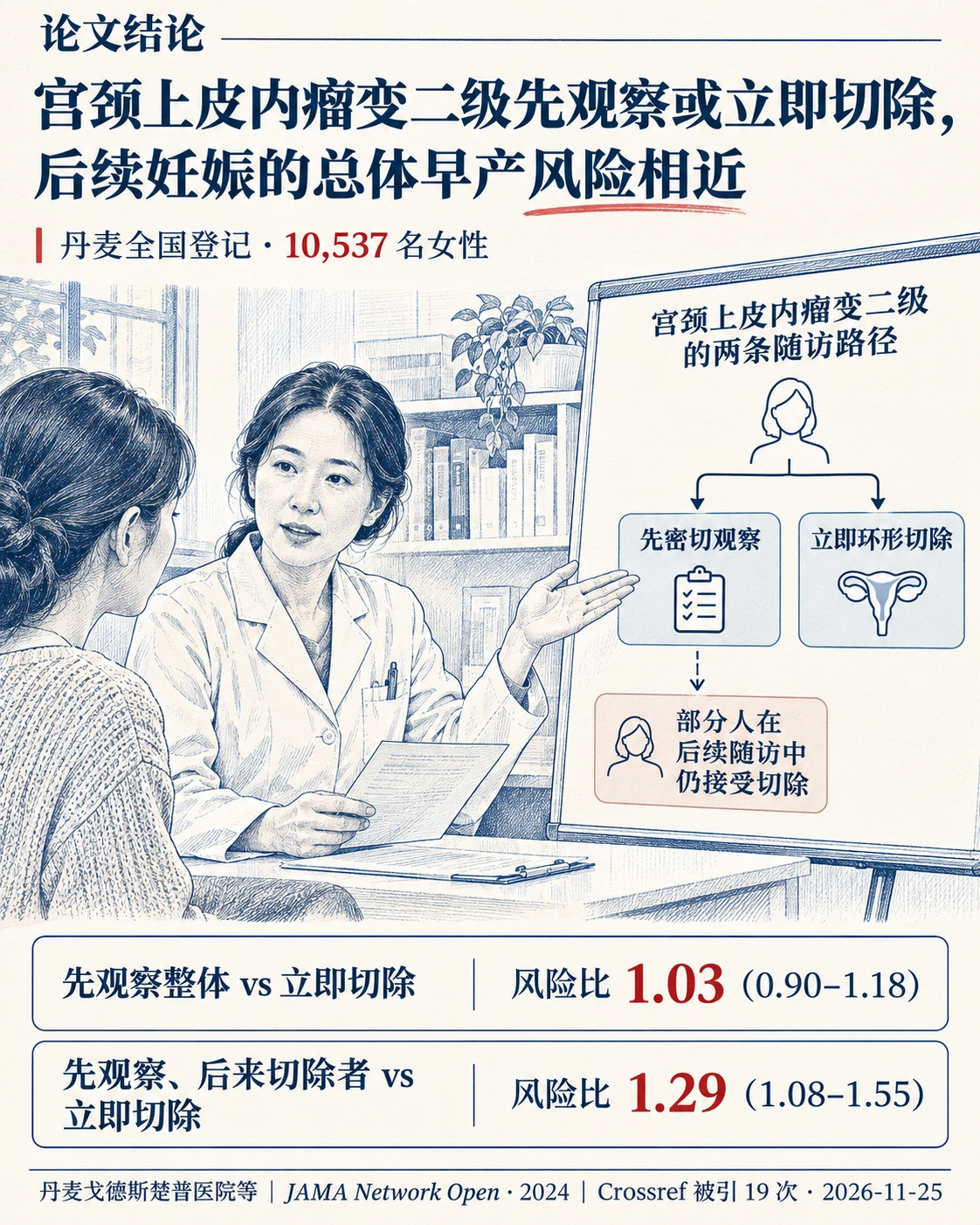
丹麦宫颈上皮内瘤变二级(CIN2)女性中,先密切观察与立即做环形切除相比,后续单胎妊娠的总体早产风险相近。先观察、随后仍需要切除者的早产风险比立即切除者高。
推荐阅读的理由
先观察并不等于一定免于手术。研究里有 4,430 名女性先接受随访,当中 1,539 人在确诊后 28 个月内还是做了环形切除。看到后一组风险较高时,需记得她们是因后续病情需要而走到这一步,不能直接推算延后手术本身的效果。
Preterm Birth Following Active Surveillance vs Loop Excision for Cervical Intraepithelial Neoplasia Grade 2
作者摘要 · 中文编译
背景与目的 许多高收入国家对 CIN2 实施主动监测,因为切除治疗与早产有关。但宫颈异常本身也与早产有关,先监测是否能降低早产风险仍不清楚。研究比较主动监测与立即做宫颈环形电切术(LEEP)后发生早产的风险。
设计与结局 这项历史人群队列来自丹麦四个医疗登记库,纳入 1998 至 2018 年首次诊断 CIN2、之后有单胎分娩的女性,排除既往 CIN3 或以上、或已做过 LEEP 者。根据确诊后的首个宫颈样本分为主动监测(宫颈活检和/或细胞学检查)和立即 LEEP。监测组再按确诊后 28 个月内是否接受延迟 LEEP 细分。早产定义为不满 37 周。研究用修正 Poisson 回归估计相对风险,倾向评分逆概率加权校正年龄、产次、年份、初始细胞学和吸烟。2022 年 10 月至 2023 年 6 月分析。
结果 10,537 人中,4,430(42%)先监测,6,107(58%)立即 LEEP。两组在确诊时均以 23 至 29 岁女性为主,分别有 3,125 人(70%)和 3,907 人(64%)。共有 869 次分娩(8.2%)早产。先监测与立即切除相比,早产风险比为 1.03(95% 置信区间 0.90 至 1.18)。监测组中,1,539 人(35%)后来接受 LEEP;她们与立即切除者相比,风险比为 1.29(1.08 至 1.55)。
结论 两种初始管理选择的后续早产风险相近。延迟切除者相对立即切除者的早产风险高约 30%。因此,在 CIN2 初诊时识别较可能需要延迟切除的人具有重要意义。
展开英文原摘要收起英文原摘要Active surveillance for cervical intraepithelial neoplasia grade 2 (CIN2) is being implemented in many high-income countries due to the association of excisional treatment with preterm birth. However, it is unknown whether active surveillance results in lower risk of preterm birth given that cervical dysplasia itself is associated with higher risk of preterm birth. To compare the preterm birth risk between women with CIN2 undergoing active surveillance or immediate loop electrosurgical excision procedure (LEEP). This historical population-based cohort study included women with a first-time diagnosis of CIN2 and a subsequent singleton birth from 1998 to 2018 in Denmark. Women with prior CIN grade 3 or greater or LEEP were excluded. Data were collected from 4 Danish health care registries. Analyses were conducted from October 2022 to June 2023. Women were categorized into active surveillance (cervical biopsy and/or cytology) or immediate LEEP based on their first cervical sample after CIN2 diagnosis. The active surveillance group was further subdivided based on whether a delayed LEEP was performed within 28 months from CIN2 diagnosis. Risk of preterm birth (<37 + 0 weeks) was assessed and relative risks (RRs) were calculated using modified Poisson regression. Analyses used inverse probability treatment weighting of the propensity scores to adjust for age, parity, calendar year, index cytology, and smoking. A total of 10 537 women with CIN2 and a singleton birth were identified; 4430 (42%) underwent active surveillance and 6107 (58%) were treated with immediate LEEP. For both groups, most were aged 23 to 29 years at CIN2 diagnosis (3125 [70%] and 3907 [64%], respectively). Overall, 869 births (8.2%) were preterm. The risk of preterm birth was comparable between active surveillance and immediate LEEP (RR, 1.03; 95% CI, 0.90-1.18). However, for women undergoing delayed LEEP after active surveillance (1539 of the active surveillance group [35%]), the risk of preterm birth was higher than for women treated with immediate LEEP (RR, 1.29; 95% CI, 1.08-1.55). In this cohort study of women with CIN2, the risk of preterm birth was comparable between active surveillance and immediate LEEP. However, delayed LEEP was associated with 30% higher risk of preterm birth than immediate LEEP. Thus, risk stratification at CIN2 diagnosis is important to identify women with increased risk of delayed LEEP.
Importance · Active surveillance for cervical intraepithelial neoplasia grade 2 (CIN2) is being implemented in many high-income countries due to the association of excisional treatment with preterm birth. However, it is unknown whether active surveillance results in lower risk of preterm birth given that cervical dysplasia itself is associated with higher risk of preterm birth.
Objective · To compare the preterm birth risk between women with CIN2 undergoing active surveillance or immediate loop electrosurgical excision procedure (LEEP).
Design, Setting, and Participants · This historical population-based cohort study included women with a first-time diagnosis of CIN2 and a subsequent singleton birth from 1998 to 2018 in Denmark. Women with prior CIN grade 3 or greater or LEEP were excluded. Data were collected from 4 Danish health care registries. Analyses were conducted from October 2022 to June 2023.
Exposure · Women were categorized into active surveillance (cervical biopsy and/or cytology) or immediate LEEP based on their first cervical sample after CIN2 diagnosis. The active surveillance group was further subdivided based on whether a delayed LEEP was performed within 28 months from CIN2 diagnosis.
Main Outcomes and Measures · Risk of preterm birth (<37 + 0 weeks) was assessed and relative risks (RRs) were calculated using modified Poisson regression. Analyses used inverse probability treatment weighting of the propensity scores to adjust for age, parity, calendar year, index cytology, and smoking.
Results · A total of 10 537 women with CIN2 and a singleton birth were identified; 4430 (42%) underwent active surveillance and 6107 (58%) were treated with immediate LEEP. For both groups, most were aged 23 to 29 years at CIN2 diagnosis (3125 [70%] and 3907 [64%], respectively). Overall, 869 births (8.2%) were preterm. The risk of preterm birth was comparable between active surveillance and immediate LEEP (RR, 1.03; 95% CI, 0.90-1.18). However, for women undergoing delayed LEEP after active surveillance (1539 of the active surveillance group [35%]), the risk of preterm birth was higher than for women treated with immediate LEEP (RR, 1.29; 95% CI, 1.08-1.55).
Conclusions and relevance · In this cohort study of women with CIN2, the risk of preterm birth was comparable between active surveillance and immediate LEEP. However, delayed LEEP was associated with 30% higher risk of preterm birth than immediate LEEP. Thus, risk stratification at CIN2 diagnosis is important to identify women with increased risk of delayed LEEP.
Kathrine Dyhr Lycke, Johnny Kahlert, Dina Overgaard Eriksen, Camilla Omann, Lars Henning Pedersen, Iben Sundtoft, Rebecca Landy, Lone Kjeld Petersen, Anne Hammer
Copyright 2024 Lycke KD et al. JAMA Network Open.
同一参照组,两种问题
| 与立即环形切除者比较 | 后续早产风险比 | 95% 置信区间 |
|---|---|---|
| 最初选择密切观察的全部女性 | 1.03 | 0.90 至 1.18 |
| 先观察,28 个月内又接受切除的女性 | 1.29 | 1.08 至 1.55 |
第二行是第一行人群的子集。 核对作者图表
作者的结论
作者认为,最初选择观察与立即切除者的整体早产风险相近。观察后仍需切除者相对风险约高三成,因此初诊时做好风险分层、识别较可能需要后续切除者很重要。
研究团队与论文影响
丹麦戈德斯楚普医院等团队联结四个全国医疗登记库,找出 1998 至 2018 年首次诊断 CIN2、之后有一次单胎分娩的女性。比较时考虑了年龄、既往分娩和吸烟等差异。
Crossref 收录本文引用 19 次。JAMA Network Open 在 2025 年度回顾中列出的期刊影响因子为 9.7。
单篇与期刊指标核查于 。
原文与延伸阅读
引用这篇文章与反馈纠错
研象编辑部.宫颈上皮内瘤变二级先观察或立即切除,后续妊娠的总体早产风险相近[EB/OL].研象,2026-11-25.https://yanxiang.hk/papers/denmark-cin2-surveillance-preterm
发现数字、译文或出处有误,可以在邮件里指出相应段落,附上核对依据。