
孕 34 至 36 周出现子痫前期时,计划分娩减少母体并发症或严重高血压,更多婴儿入住新生儿病房
The Lancet2019随机对照试验Crossref 记录被引 180 次
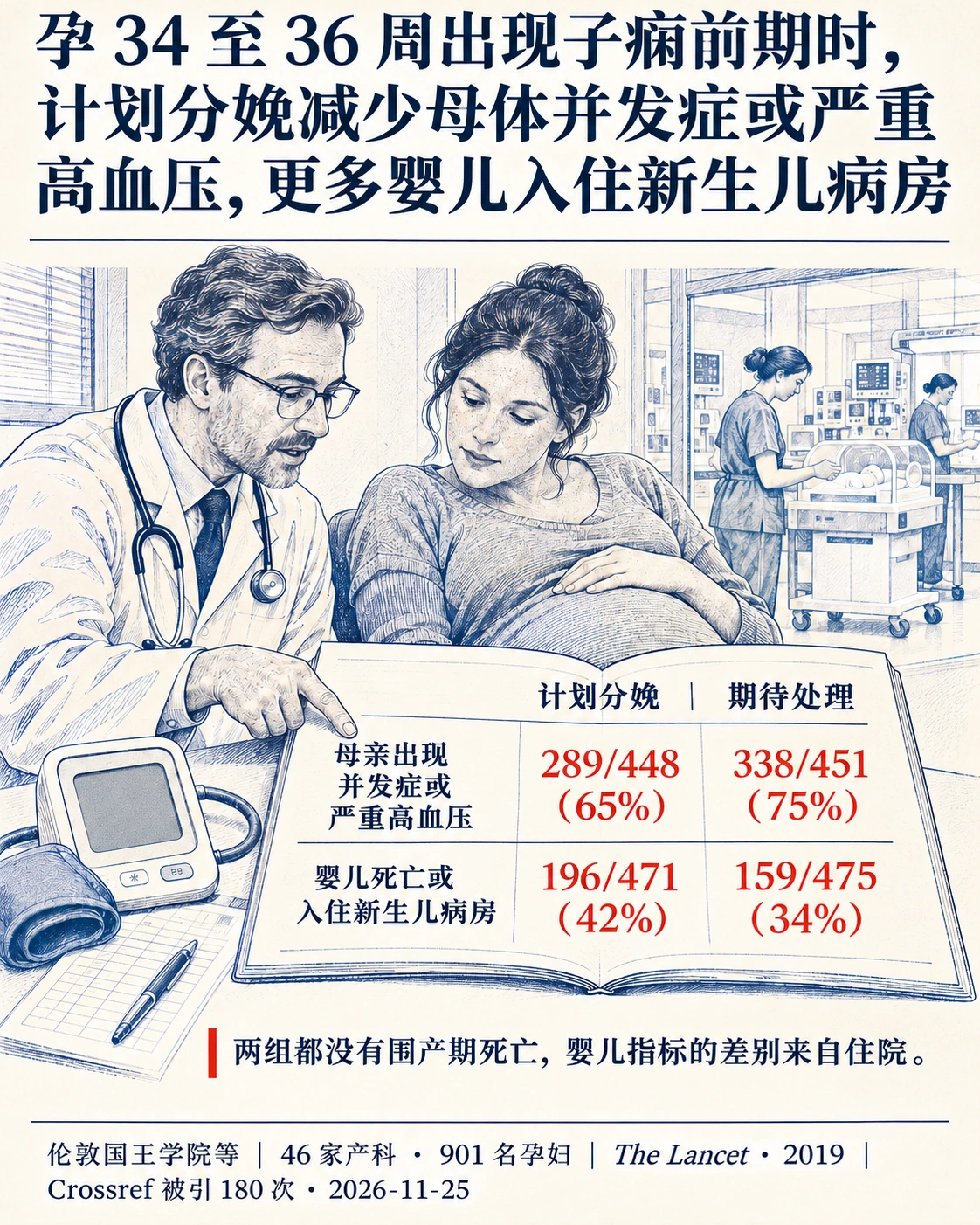
医生同时看两张记录,一张是母亲的,一张是婴儿的
孕 34 周至不足 37 周发生子痫前期时,计划分娩组较少出现母体并发症或严重高血压。婴儿更常入住新生儿病房,研究没有观察到病情更重的证据。
推荐阅读的理由
继续等待可以让胎儿在宫内多发育一段时间,但母亲的子痫前期可能加重。PHOENIX 分别统计每位母亲是否出现并发症或严重高血压,以及每名婴儿是否死亡或入住新生儿病房。把两项结果放在一起,才看得到提前分娩的取舍。
Planned early delivery or expectant management for late preterm pre-eclampsia (PHOENIX): a randomised controlled trial
作者摘要 · 中文编译
背景 妊娠晚期早产阶段发生子痫前期时,应何时分娩尚不清楚。限制母体疾病进展,要与婴儿发生并发症的风险权衡。试验比较计划较早分娩与期待处理,考察能否减少母体不良结局,同时避免新生儿或婴儿结局明显恶化。
方法 这是一项开放标签、平行分组、多中心随机试验,在英格兰和威尔士 46 家产科单位开展。孕 34 周至不足 37 周、有子痫前期的单胎或双绒毛膜双羊膜囊双胎孕妇,按个人随机分配。母体共同主要结局为母体并发症或收缩压至少 160 mmHg,检验计划分娩是否更优。围产期共同主要结局为婴儿出院前围产期死亡或入住新生儿病房,非劣效界值为发生率相差 10 个百分点。按最初分组分析,围产期结局另作按方案分析。预注册号 ISRCTN01879376,论文发表时已结束招募,随访仍在继续。
结果 2014 年 9 月 29 日至 2018 年 12 月 10 日入组 901 名孕妇。计划分娩组随机入组 450 人,分析 448 名母亲和 471 名婴儿;期待处理组为 451 名母亲和 475 名婴儿。母体结局发生率分别为 65%(289 人)和 75%(338 人),校正相对风险 0.86(95% 置信区间 0.79 至 0.94,P=0.0005)。围产期结局分别为 42%(196 名婴儿)和 34%(159 名),校正相对风险 1.26(1.08 至 1.47,P=0.0034)。按方案分析结果相似。两组分别有 9 和 12 起严重不良事件。
解释 计划分娩能减少母体并发症和严重高血压,但更多新生儿因早产而入住新生儿病房。没有指标显示新生儿发病程度更高。作者建议与孕妇讨论这种取舍,共同决定分娩时机。
资助 英国国家健康研究院健康技术评估项目。
展开英文原摘要收起英文原摘要In women with late preterm pre-eclampsia, the optimal time to initiate delivery is unclear because limitation of maternal disease progression needs to be balanced against infant complications. The aim of this trial was to determine whether planned earlier initiation of delivery reduces maternal adverse outcomes without substantial worsening of neonatal or infant outcomes, compared with expectant management (usual care) in women with late preterm pre-eclampsia. In this parallel-group, non-masked, multicentre, randomised controlled trial done in 46 maternity units across England and Wales, we compared planned delivery versus expectant management (usual care) with individual randomisation in women with late preterm pre-eclampsia from 34 to less than 37 weeks' gestation and a singleton or dichorionic diamniotic twin pregnancy. The co-primary maternal outcome was a composite of maternal morbidity or recorded systolic blood pressure of at least 160 mm Hg with a superiority hypothesis. The co-primary perinatal outcome was a composite of perinatal deaths or neonatal unit admission up to infant hospital discharge with a non-inferiority hypothesis (non-inferiority margin of 10% difference in incidence). Analyses were by intention to treat, together with a per-protocol analysis for the perinatal outcome. The trial was prospectively registered with the ISRCTN registry, ISRCTN01879376. The trial is closed to recruitment but follow-up is ongoing. Between Sept 29, 2014, and Dec 10, 2018, 901 women were recruited. 450 women (448 women and 471 infants analysed) were allocated to planned delivery and 451 women (451 women and 475 infants analysed) to expectant management. The incidence of the co-primary maternal outcome was significantly lower in the planned delivery group (289 [65%] women) compared with the expectant management group (338 [75%] women; adjusted relative risk 0·86, 95% CI 0·79–0·94; p=0·0005). The incidence of the co-primary perinatal outcome by intention to treat was significantly higher in the planned delivery group (196 [42%] infants) compared with the expectant management group (159 [34%] infants; 1·26, 1·08–1·47; p=0·0034). The results from the per-protocol analysis were similar. There were nine serious adverse events in the planned delivery group and 12 in the expectant management group. There is strong evidence to suggest that planned delivery reduces maternal morbidity and severe hypertension compared with expectant management, with more neonatal unit admissions related to prematurity but no indicators of greater neonatal morbidity. This trade-off should be discussed with women with late preterm pre-eclampsia to allow shared decision making on timing of delivery. National Institute for Health Research Health Technology Assessment Programme.
Background · In women with late preterm pre-eclampsia, the optimal time to initiate delivery is unclear because limitation of maternal disease progression needs to be balanced against infant complications. The aim of this trial was to determine whether planned earlier initiation of delivery reduces maternal adverse outcomes without substantial worsening of neonatal or infant outcomes, compared with expectant management (usual care) in women with late preterm pre-eclampsia.
Methods · In this parallel-group, non-masked, multicentre, randomised controlled trial done in 46 maternity units across England and Wales, we compared planned delivery versus expectant management (usual care) with individual randomisation in women with late preterm pre-eclampsia from 34 to less than 37 weeks' gestation and a singleton or dichorionic diamniotic twin pregnancy. The co-primary maternal outcome was a composite of maternal morbidity or recorded systolic blood pressure of at least 160 mm Hg with a superiority hypothesis. The co-primary perinatal outcome was a composite of perinatal deaths or neonatal unit admission up to infant hospital discharge with a non-inferiority hypothesis (non-inferiority margin of 10% difference in incidence). Analyses were by intention to treat, together with a per-protocol analysis for the perinatal outcome. The trial was prospectively registered with the ISRCTN registry, ISRCTN01879376. The trial is closed to recruitment but follow-up is ongoing.
Findings · Between Sept 29, 2014, and Dec 10, 2018, 901 women were recruited. 450 women (448 women and 471 infants analysed) were allocated to planned delivery and 451 women (451 women and 475 infants analysed) to expectant management. The incidence of the co-primary maternal outcome was significantly lower in the planned delivery group (289 [65%] women) compared with the expectant management group (338 [75%] women; adjusted relative risk 0·86, 95% CI 0·79–0·94; p=0·0005). The incidence of the co-primary perinatal outcome by intention to treat was significantly higher in the planned delivery group (196 [42%] infants) compared with the expectant management group (159 [34%] infants; 1·26, 1·08–1·47; p=0·0034). The results from the per-protocol analysis were similar. There were nine serious adverse events in the planned delivery group and 12 in the expectant management group.
Interpretation · There is strong evidence to suggest that planned delivery reduces maternal morbidity and severe hypertension compared with expectant management, with more neonatal unit admissions related to prematurity but no indicators of greater neonatal morbidity. This trade-off should be discussed with women with late preterm pre-eclampsia to allow shared decision making on timing of delivery.
Funding · National Institute for Health Research Health Technology Assessment Programme.
Lucy C Chappell, Peter Brocklehurst, Marcus E Green, Rachael Hunter, Pollyanna Hardy, Edmund Juszczak, Louise Linsell, Virginia Chiocchia, Melanie Greenland, Anna Placzek, John Townend, Neil Marlow, Jane Sandall, Andrew Shennan, PHOENIX Study Group
© 2019 The Author(s). Published by Elsevier Ltd. This is an Open Access article under the CC BY 4.0 license
同一种分娩安排,对母亲和婴儿分别意味着什么?
| 共同主要结局 | 计划分娩 | 期待处理 |
|---|---|---|
| 母体并发症或收缩压 ≥160 mmHg | 289/448(65%) | 338/451(75%) |
| 围产期死亡或新生儿入住病房 | 196/471(42%) | 159/475(34%) |
校正相对风险,母体结局为 0.86(95% 置信区间 0.79 至 0.94),围产期结局为 1.26(1.08 至 1.47)。 核对作者图表
作者的结论
作者认为,和期待处理相比,计划分娩能够减少母体发病和严重高血压。代价是更多新生儿因早产而住院,其他指标未提示新生儿发病情况更重。这些结果有助于孕妇和临床团队共同讨论分娩时机。
研究团队与论文影响
伦敦国王学院等单位在英格兰和威尔士 46 家产科单位开展 PHOENIX 多中心随机试验。试验纳入 901 名孕妇,包括单胎及双绒毛膜双羊膜囊双胎,母婴结果用不同分母统计。
Crossref 收录本文引用 180 次。
单篇与期刊指标核查于 。
原文与延伸阅读
引用这篇文章与反馈纠错
研象编辑部.孕 34 至 36 周出现子痫前期时,计划分娩减少母体并发症或严重高血压,更多婴儿入住新生儿病房[EB/OL].研象,2026-11-25.https://yanxiang.hk/papers/obstetrics-phoenix
发现数字、译文或出处有误,可以在邮件里指出相应段落,附上核对依据。