
医生能用 GPT-4,病例推理得分并未显著提高
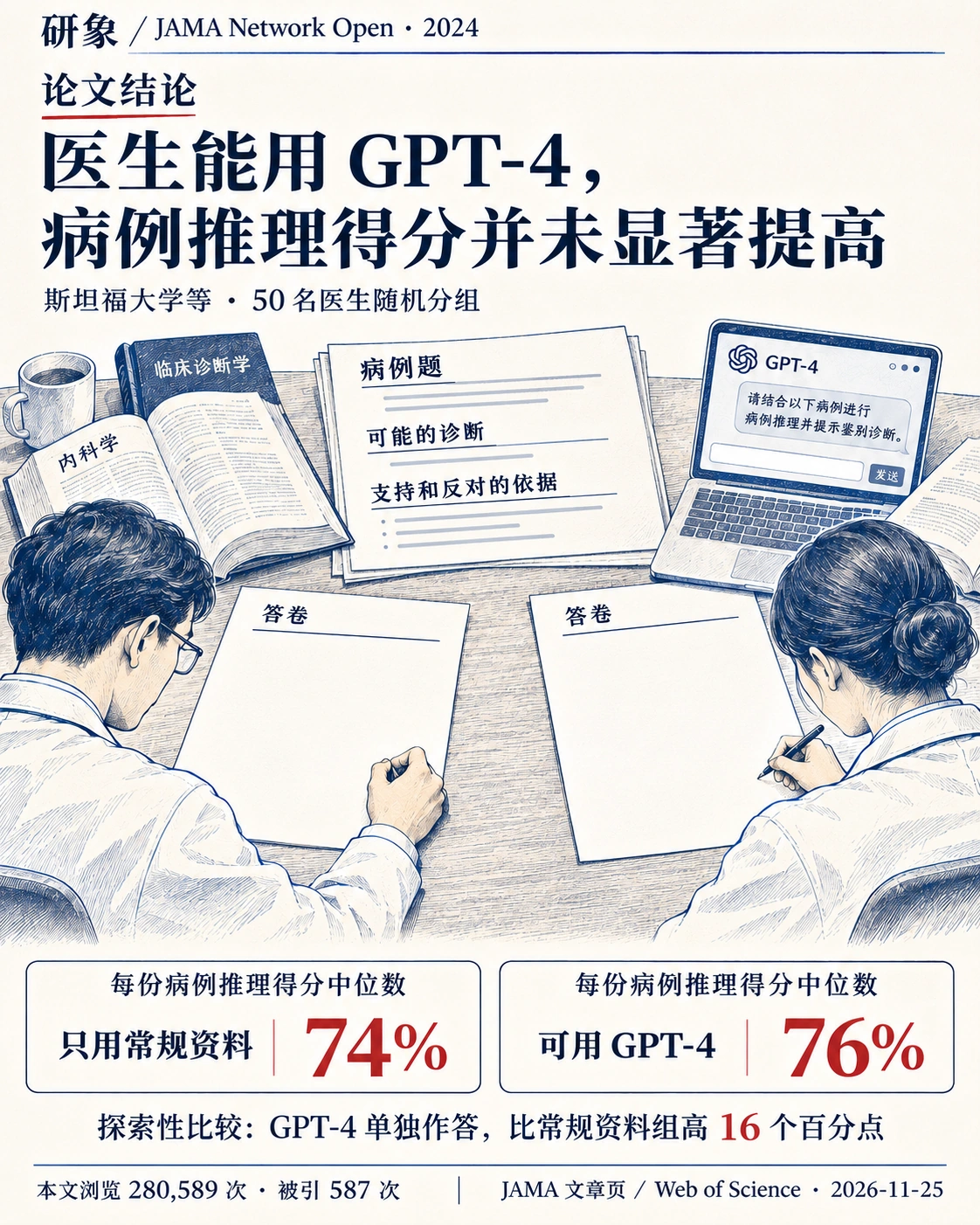
JAMA Network Open2024随机对照试验研究团队与论文影响
模型会答题,配给医生之后会怎样?
给医生同样一份疑难病例,请他们写出可能的诊断、支持和反对的证据,以及下一步检查。可以使用 GPT-4 的医生中位得分为 76%,只查常规资料的医生为 74%。
推荐阅读的理由
这篇论文把两个容易混淆的问题分开做了。先把医生随机分组,问多一个工具能不能改善实际答卷。随后把病例直接交给模型,发现模型单独答题的成绩更高。由此看出,挑选一个在考试里得高分的模型,和让医生在有限时间里用好它,是两项需要分别检验的工作。
Large Language Model Influence on Diagnostic Reasoning: A Randomized Clinical Trial
作者摘要 · 中文编译
背景与目的 大语言模型在选择题和开放式医学推理题上表现良好。研究者想知道,与常规诊断资料相比,给医生提供大模型能否改善医生自己的诊断推理。
设计 2023 年 11 月 29 日至 12 月 29 日,研究者通过远程视频和线下方式,在多家学术医疗机构招募接受过家庭医学、内科或急诊医学培训的医生,开展单盲随机试验。
干预 按职业阶段分层后随机分组。一组可同时使用大模型和常规资料,另一组只用常规资料。每人有 60 分钟,最多完成 6 份临床病例题。
主要指标 专家在不知道分组的情况下,按经验证的标准共同评分,考察鉴别诊断是否准确、支持和反对的理由是否恰当,以及接下来打算怎样检查。次要指标包括每例耗时和最后诊断的准确性。所有医生按最初分组分析。另一项探索性分析比较了模型单独作答与医生只用常规资料时的成绩。
结果 50 名医生参加,包括 26 名主治医生和 24 名住院医生。执业时间中位数 3 年,四分位范围 2 至 8 年。可用大模型组每例中位得分 76%(四分位范围 66% 至 87%),常规组 74%(63% 至 84%)。校正后相差 2 个百分点(95% 置信区间 −4 至 8,P=0.60)。每例耗时中位数分别为 519 秒(371 至 668)和 565 秒(456 至 788),模型估算的时间差为 −82 秒(95% 置信区间 −195 至 31,P=0.20)。模型单独作答比常规组高 16 个百分点(95% 置信区间 2 至 30,P=0.03)。
结论 在此次试验中,向医生开放大模型作为诊断辅助,没有显著提高临床推理表现。模型单独作答的表现高于两组医生。作者认为,要在临床中发挥人机合作的潜力,技术和人员使用工具的方式都还需要发展。
注册 ClinicalTrials.gov 编号 NCT06157944。
展开英文原摘要收起英文原摘要Large language models (LLMs) have shown promise in their performance on both multiple-choice and open-ended medical reasoning examinations, but it remains unknown whether the use of such tools improves physician diagnostic reasoning. To assess the effect of an LLM on physicians’ diagnostic reasoning compared with conventional resources. A single-blind randomized clinical trial was conducted from November 29 to December 29, 2023. Using remote video conferencing and in-person participation across multiple academic medical institutions, physicians with training in family medicine, internal medicine, or emergency medicine were recruited. Participants were randomized to either access the LLM in addition to conventional diagnostic resources or conventional resources only, stratified by career stage. Participants were allocated 60 minutes to review up to 6 clinical vignettes. The primary outcome was performance on a standardized rubric of diagnostic performance based on differential diagnosis accuracy, appropriateness of supporting and opposing factors, and next diagnostic evaluation steps, validated and graded via blinded expert consensus. Secondary outcomes included time spent per case (in seconds) and final diagnosis accuracy. All analyses followed the intention-to-treat principle. A secondary exploratory analysis evaluated the standalone performance of the LLM by comparing the primary outcomes between the LLM alone group and the conventional resource group. Fifty physicians (26 attendings, 24 residents; median years in practice, 3 [IQR, 2-8]) participated virtually as well as at 1 in-person site. The median diagnostic reasoning score per case was 76% (IQR, 66%-87%) for the LLM group and 74% (IQR, 63%-84%) for the conventional resources-only group, with an adjusted difference of 2 percentage points (95% CI, −4 to 8 percentage points; P = .60). The median time spent per case for the LLM group was 519 (IQR, 371-668) seconds, compared with 565 (IQR, 456-788) seconds for the conventional resources group, with a time difference of −82 (95% CI, −195 to 31; P = .20) seconds. The LLM alone scored 16 percentage points (95% CI, 2-30 percentage points; P = .03) higher than the conventional resources group. In this trial, the availability of an LLM to physicians as a diagnostic aid did not significantly improve clinical reasoning compared with conventional resources. The LLM alone demonstrated higher performance than both physician groups, indicating the need for technology and workforce development to realize the potential of physician-artificial intelligence collaboration in clinical practice. ClinicalTrials.gov Identifier: NCT06157944
Importance · Large language models (LLMs) have shown promise in their performance on both multiple-choice and open-ended medical reasoning examinations, but it remains unknown whether the use of such tools improves physician diagnostic reasoning.
Objective · To assess the effect of an LLM on physicians’ diagnostic reasoning compared with conventional resources.
Design, Setting, and Participants · A single-blind randomized clinical trial was conducted from November 29 to December 29, 2023. Using remote video conferencing and in-person participation across multiple academic medical institutions, physicians with training in family medicine, internal medicine, or emergency medicine were recruited.
Intervention · Participants were randomized to either access the LLM in addition to conventional diagnostic resources or conventional resources only, stratified by career stage. Participants were allocated 60 minutes to review up to 6 clinical vignettes.
Main Outcomes and Measures · The primary outcome was performance on a standardized rubric of diagnostic performance based on differential diagnosis accuracy, appropriateness of supporting and opposing factors, and next diagnostic evaluation steps, validated and graded via blinded expert consensus. Secondary outcomes included time spent per case (in seconds) and final diagnosis accuracy. All analyses followed the intention-to-treat principle. A secondary exploratory analysis evaluated the standalone performance of the LLM by comparing the primary outcomes between the LLM alone group and the conventional resource group.
Results · Fifty physicians (26 attendings, 24 residents; median years in practice, 3 [IQR, 2-8]) participated virtually as well as at 1 in-person site. The median diagnostic reasoning score per case was 76% (IQR, 66%-87%) for the LLM group and 74% (IQR, 63%-84%) for the conventional resources-only group, with an adjusted difference of 2 percentage points (95% CI, −4 to 8 percentage points; P = .60). The median time spent per case for the LLM group was 519 (IQR, 371-668) seconds, compared with 565 (IQR, 456-788) seconds for the conventional resources group, with a time difference of −82 (95% CI, −195 to 31; P = .20) seconds. The LLM alone scored 16 percentage points (95% CI, 2-30 percentage points; P = .03) higher than the conventional resources group.
Conclusions and Relevance · In this trial, the availability of an LLM to physicians as a diagnostic aid did not significantly improve clinical reasoning compared with conventional resources. The LLM alone demonstrated higher performance than both physician groups, indicating the need for technology and workforce development to realize the potential of physician-artificial intelligence collaboration in clinical practice.
Trial Registration · ClinicalTrials.gov Identifier: NCT06157944
Ethan Goh, Robert Gallo, Jason Hom, Eric Strong, Yingjie Weng, Hannah Kerman, Joséphine A Cool, Zahir Kanjee, Andrew S Parsons, Neera Ahuja, Eric Horvitz, Daniel Yang, Arnold Milstein, Andrew P J Olson, Adam Rodman, Jonathan H Chen
Copyright 2024 Goh E et al. JAMA Network Open.
同一套评分标准下,医生的答卷相差多少?
| 诊断推理评分 | 结果 |
|---|---|
| 医生可用 GPT-4 | 中位数 76% |
| 医生只用常规资料 | 中位数 74% |
| 校正后的组间差 | 2 个百分点(95% 置信区间 −4 至 8) |
| GPT-4 单独作答,与常规资料组比较 | 高 16 个百分点(探索性分析) |
表 2 的主要比较是医生的两种工作条件。区间既容得下小幅下降,也容得下小幅提高。 核对作者图表
作者的结论
作者认为,在这次病例推理试验中,给医生提供大模型没有显著提高他们的得分。模型单独作答的表现提示,临床团队还需要研究怎样把工具真正用进推理过程。
研究团队与论文影响
斯坦福大学、贝斯以色列女执事医疗中心、弗吉尼亚大学等机构参与。50 名持有美国执照的医生来自内科、家庭医学和急诊医学。专家在不知道分组的情况下给答案评分。
JAMA 文章页记录本文浏览 280,589 次,Web of Science 被引 587 次。该刊 2025 年度回顾列出的期刊影响因子为 9.7。
单篇与期刊指标核查于 。
原文与延伸阅读
引用这篇文章与反馈纠错
研象编辑部.医生能用 GPT-4,病例推理得分并未显著提高[EB/OL].研象,2026-11-25.https://yanxiang.hk/papers/gpt4-physician-reasoning
发现数字、译文或出处有误,可以在邮件里指出相应段落,附上核对依据。