
韩国急诊医生修改模型初稿,写出院记录的时间约减半,成稿比手写更完整
JAMA Network Open2025医疗技术验证Crossref 记录被引 49 次
省下来的半分钟,换来了什么样的病历?
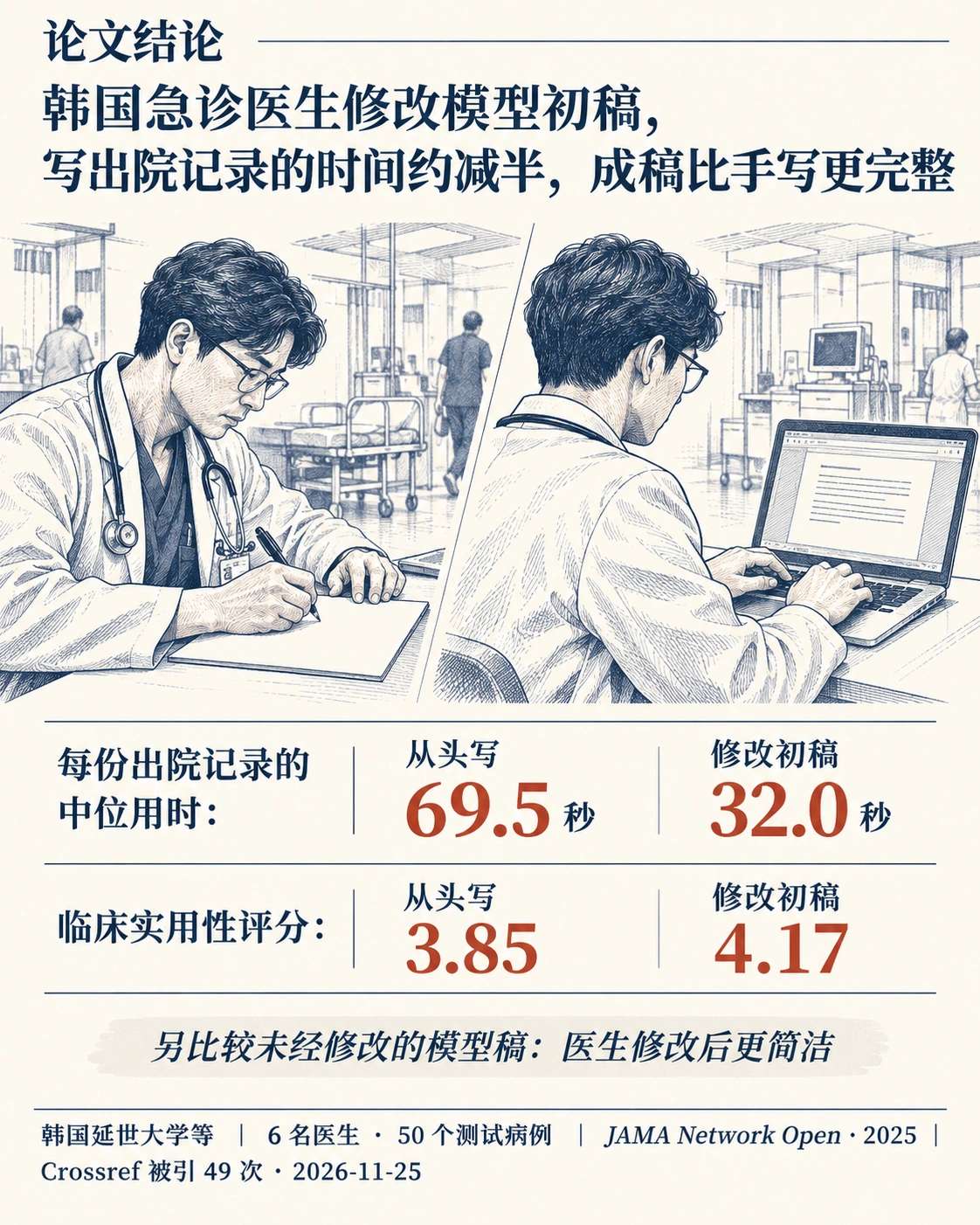
同样 50 个急诊病例,6 名医生从头写出院记录,中位每份用 69.5 秒;修改模型初稿用 32 秒。独立评分者认为,辅助撰写的成稿比纯手写更完整、准确、简洁,临床实用性也更高。
推荐阅读的理由
研究同时保留了医生手写、模型初稿和医生改稿三个版本。比较头尾两个版本,可以判断这种工作方式是否划算。再把初稿拿回来比较,会看到医生修改最明显的贡献是让文字更简洁;在这批病例中,初稿的完整性和正确性评分甚至略高于改稿。
Large Language Model Assistant for Emergency Department Discharge Documentation
作者摘要 · 中文编译
背景与目的 急诊出院记录费时,内容也可能不完整。作者开发一套语言模型助手,用来起草记录,并评估记录质量与工作效率。
设计 在韩国一家 2,400 床的三级医院,使用 2022 年 9 月至 2023 年 8 月的急诊资料。研究包括 17 岁及以上患者,以及因创伤、中毒、烧伤等非疾病原因就诊的儿童。急诊医生选出 592 个有代表性的病例训练模型,另取 50 个验证。在前瞻性顺序验证中,6 名医生先手写记录,间隔 1 小时后编辑模型初稿。3 名独立医生评价 300 套记录,每套含手写、初稿及改稿三个版本。
干预与结局 研究用 592 例微调商用文本生成模型。仅由急诊医生处理的病例输入首次病历和处方清单,需要专科会诊的病例输入首次病历和会诊申请。研究记录写作用时,并以 1 至 5 分评价完整性、正确性、简洁性和临床实用性。
结果 50 个测试病例平均年龄 57.7 岁(标准差 23.1),28 人(56%)为女性。医生改稿的四项评分依次为 4.23(95% 置信区间 4.17 至 4.28)、4.38(4.33 至 4.42)、4.23(4.18 至 4.28)、4.17(4.11 至 4.23)。手写分别为 4.03(3.96 至 4.09)、4.20(4.14 至 4.26)、4.11(4.05 至 4.17)、3.85(3.78 至 3.91),四项比较 P 值均小于 0.001。与模型初稿相比,改稿更简洁(初稿 3.98,3.91 至 4.04),实用性接近(初稿 4.16,4.11 至 4.21),但完整性(初稿 4.34,4.29 至 4.39)和正确性(初稿 4.45,4.41 至 4.49)评分略低。手写及改稿的中位用时分别为 69.5 秒(65.5 至 78.0)和 32.0 秒(29.5 至 36.0),P 值小于 0.001。
结论 与手写相比,院内部署的语言模型助手与急诊出院记录写作时间缩短相关,同时维持了文书质量。作者认为这对人工智能参与临床工作具有意义。
展开英文原摘要收起英文原摘要Emergency department (ED) discharge documentation is time-consuming and often incomplete. To develop a large language model (LLM) assistant that generates ED discharge notes and to evaluate its effectiveness on documentation quality and workflow efficiency. This comparative effectiveness study, which was conducted at a 2400-bed tertiary care hospital in South Korea, consisted of 2 primary phases: a development phase and sequential validation of the LLM assistant. In the randomized sequential prospective validation, 6 emergency physicians first wrote discharge notes manually (session 1), then edited LLM-generated drafts after a 1-hour washout period (session 2). Three independent physicians evaluated 300 note sets (each containing a manual note, an LLM draft, and an LLM-assisted note). For model development and validation, patient records from ED visits between September 1, 2022, and August 31, 2023, were used. The inclusion criteria encompassed adult patients (aged ≥17 years) and pediatric patients with nondisease conditions (eg, trauma, poisoning, or burns). Emergency physicians selected 592 representative cases for training and 50 for validation. A commercially available text generation transformer model was used as a core LLM, fine-tuned using the 592 training cases. Two distinct processing pipelines were implemented within the LLM assistant due to different input data: (1) for patients managed solely by emergency physicians, using the ED initial record and prescription list, and (2) for those requiring specialty consultations, using the ED initial record and consultation request form. Quality of notes using 4C metrics (completeness, correctness, conciseness, and clinical utility) on a Likert scale ranging from 1 to 5 and time taken to complete the notes manually and with the LLM assistant. Of the 50 test cases, the mean (SD) patient age was 57.7 (23.1) years, and 28 patients (56%) were female. LLM-assisted notes achieved higher scores than manual notes in completeness (4.23 [95% CI, 4.17-4.28] vs 4.03 [95% CI, 3.96-4.09]), correctness (4.38 [95% CI, 4.33-4.42] vs 4.20 [95% CI, 4.14-4.26]), conciseness (4.23 [95% CI, 4.18-4.28] vs 4.11 [95% CI, 4.05-4.17]), and clinical utility (4.17 [95% CI, 4.11-4.23] vs 3.85 [95% CI, 3.78-3.91]) (all P < .001). When compared with LLM drafts, LLM-assisted notes excelled in conciseness (4.23 vs 3.98 [95% CI, 3.91-4.04]; P < .001) and maintained equivalent clinical utility (4.17 vs 4.16 [95% CI, 4.11-4.21]; P > .99), but scored lower in completeness (4.23 vs 4.34 [95% CI, 4.29-4.39]; P = .001) and correctness (4.38 vs 4.45 [95% CI, 4.41-4.49]; P < .001). The median documentation time per note dropped from 69.5 (95% CI, 65.5-78.0) seconds for manual notes to 32.0 (95% CI, 29.5-36.0) seconds for LLM-assisted notes (P < .001). In this comparative effectiveness study, use of an on-site LLM assistant was associated with reduced writing time for ED discharge notes compared with manual note-taking, without compromising documentation quality, representing a critical advancement in the use of artificial intelligence for clinical practice.
Importance · Emergency department (ED) discharge documentation is time-consuming and often incomplete.
Objective · To develop a large language model (LLM) assistant that generates ED discharge notes and to evaluate its effectiveness on documentation quality and workflow efficiency.
Design, Setting, and Participants · This comparative effectiveness study, which was conducted at a 2400-bed tertiary care hospital in South Korea, consisted of 2 primary phases: a development phase and sequential validation of the LLM assistant. In the randomized sequential prospective validation, 6 emergency physicians first wrote discharge notes manually (session 1), then edited LLM-generated drafts after a 1-hour washout period (session 2). Three independent physicians evaluated 300 note sets (each containing a manual note, an LLM draft, and an LLM-assisted note). For model development and validation, patient records from ED visits between September 1, 2022, and August 31, 2023, were used. The inclusion criteria encompassed adult patients (aged ≥17 years) and pediatric patients with nondisease conditions (eg, trauma, poisoning, or burns). Emergency physicians selected 592 representative cases for training and 50 for validation.
Exposure · A commercially available text generation transformer model was used as a core LLM, fine-tuned using the 592 training cases. Two distinct processing pipelines were implemented within the LLM assistant due to different input data: (1) for patients managed solely by emergency physicians, using the ED initial record and prescription list, and (2) for those requiring specialty consultations, using the ED initial record and consultation request form.
Main Outcomes and Measures · Quality of notes using 4C metrics (completeness, correctness, conciseness, and clinical utility) on a Likert scale ranging from 1 to 5 and time taken to complete the notes manually and with the LLM assistant.
Results · Of the 50 test cases, the mean (SD) patient age was 57.7 (23.1) years, and 28 patients (56%) were female. LLM-assisted notes achieved higher scores than manual notes in completeness (4.23 [95% CI, 4.17-4.28] vs 4.03 [95% CI, 3.96-4.09]), correctness (4.38 [95% CI, 4.33-4.42] vs 4.20 [95% CI, 4.14-4.26]), conciseness (4.23 [95% CI, 4.18-4.28] vs 4.11 [95% CI, 4.05-4.17]), and clinical utility (4.17 [95% CI, 4.11-4.23] vs 3.85 [95% CI, 3.78-3.91]) (all P < .001). When compared with LLM drafts, LLM-assisted notes excelled in conciseness (4.23 vs 3.98 [95% CI, 3.91-4.04]; P < .001) and maintained equivalent clinical utility (4.17 vs 4.16 [95% CI, 4.11-4.21]; P > .99), but scored lower in completeness (4.23 vs 4.34 [95% CI, 4.29-4.39]; P = .001) and correctness (4.38 vs 4.45 [95% CI, 4.41-4.49]; P < .001). The median documentation time per note dropped from 69.5 (95% CI, 65.5-78.0) seconds for manual notes to 32.0 (95% CI, 29.5-36.0) seconds for LLM-assisted notes (P < .001).
Conclusion · In this comparative effectiveness study, use of an on-site LLM assistant was associated with reduced writing time for ED discharge notes compared with manual note-taking, without compromising documentation quality, representing a critical advancement in the use of artificial intelligence for clinical practice.
Ji Woo Song, Junseong Park, Ji Hoon Kim, Seng Chan You
Copyright 2025 Song JW et al. JAMA Network Open.
把手写、模型初稿和医生改稿并排看
| 指标 | 从头手写 | 模型初稿 | 医生改稿 |
|---|---|---|---|
| 完整性/5 分 | 4.03 | 4.34 | 4.23 |
| 正确性/5 分 | 4.20 | 4.45 | 4.38 |
| 简洁性/5 分 | 4.11 | 3.98 | 4.23 |
| 临床实用性/5 分 | 3.85 | 4.16 | 4.17 |
| 单份医生用时中位数 | 69.5 秒 | 不适用 | 32.0 秒 |
原文图 3 列出四项评分,图 5 列出医生用时。 核对作者图表
作者的结论
作者认为,在本院系统内使用语言模型起草急诊出院记录,医生写作时间缩短,记录质量也得以维持。所有医生都先手写、后改稿,研究尚不能完全分开熟悉病例和使用工具各自的作用。
研究团队与论文影响
韩国延世大学等在首尔一所设有 2,400 张床位的三级医院进行验证。三名独立医生给 300 套记录评分,每套都有同一病例的三个版本。
Crossref 收录本文引用 49 次。JAMA Network Open 在 2025 年度回顾中列出的期刊影响因子为 9.7。
单篇与期刊指标核查于 。
原文与延伸阅读
引用这篇文章与反馈纠错
研象编辑部.韩国急诊医生修改模型初稿,写出院记录的时间约减半,成稿比手写更完整[EB/OL].研象,2026-11-25.https://yanxiang.hk/papers/korea-llm-emergency-discharge-notes
发现数字、译文或出处有误,可以在邮件里指出相应段落,附上核对依据。