
从手机眼底视频筛查早产儿视网膜病变,模型检出更多患儿,也报出更多假阳性
JAMA Network Open2025诊断准确性研究Crossref 记录被引 26 次
拍得到和看得准,是筛查的两道关。
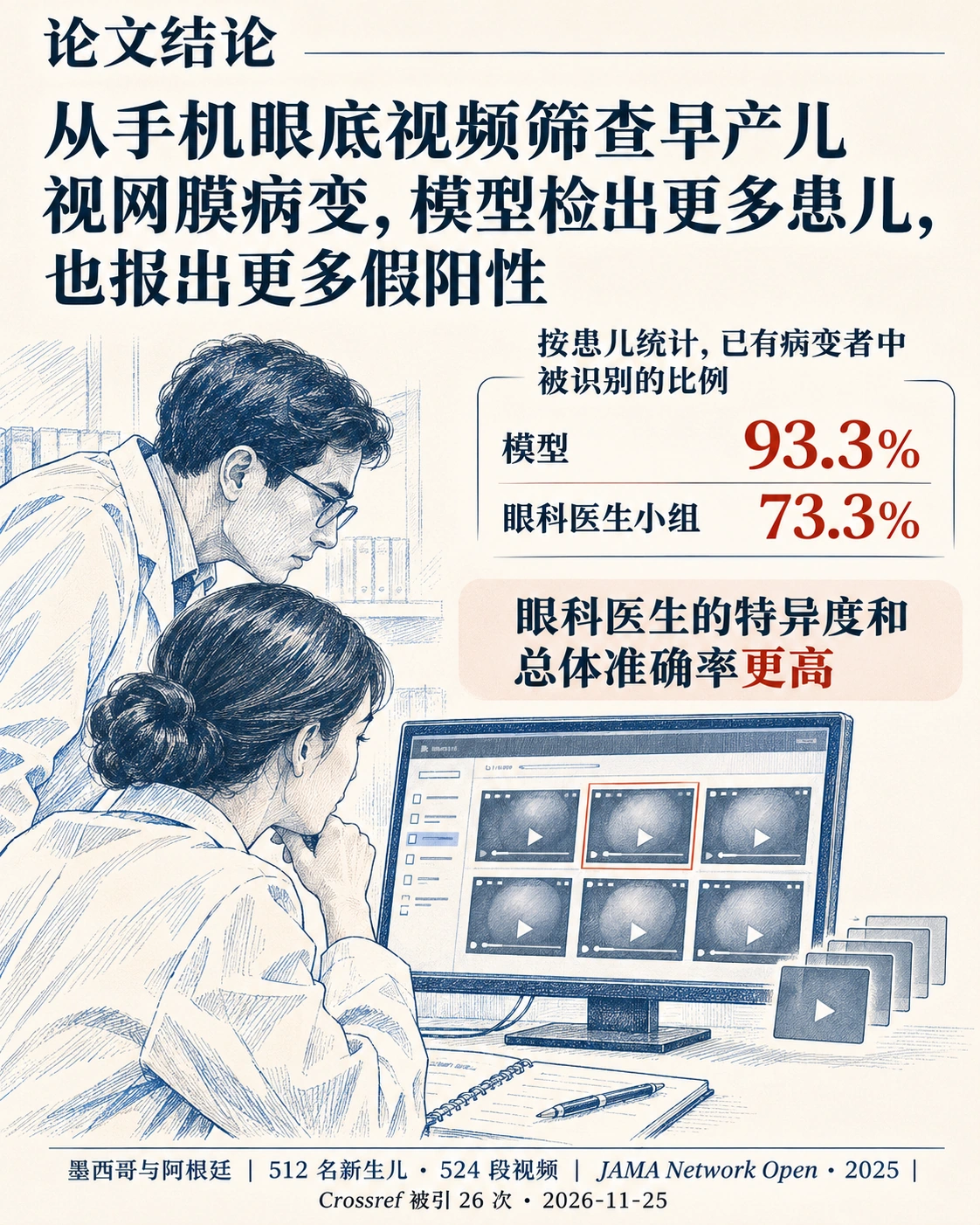
用手机配低成本放大镜拍下早产儿眼底,再请模型从视频挑帧、识别病变。按患儿统计,模型找出了 93.3% 的患病者,医生小组从选出的画面认出 73.3%。模型也把更多无病患儿判成阳性。
推荐阅读的理由
在缺少专用眼底相机的地方,一段手机视频可能只有少数画面拍清了视网膜。研究先问模型能不能选出可读的帧,再问这些帧能否让人认出病变。筛查如果更怕漏掉患儿,模型的高敏感度有吸引力;专科复核能否接住更多阳性结果,同样影响这种做法能服务多少人。
AI-Enabled Screening for Retinopathy of Prematurity in Low-Resource Settings
作者摘要 · 中文编译
背景与目的 早产儿视网膜病变是全球可预防儿童失明的主要原因。及时发现并治疗可避免相关失明,但持续筛查需要儿童眼科医生和专用相机,这些资源在部分地区有限。研究开发并评估一种分析手机视频的筛查算法。
设计与方法 在墨西哥和阿根廷,研究使用 2020 年 5 月至 2023 年 10 月拍摄的早产儿眼底视频,纳入胎龄不足 36 周或出生体重低于 1,500 克的新生儿。算法挑选较清晰的帧并判断是否可能有病变。研究评估它找到高质量眼底图像的能力,并在单帧和患儿两个层面将分类表现与三位儿童眼科医生比较。
结果 512 名新生儿共提供 524 段视频。胎龄中位数为 32 周(25 至 36 周),出生体重中位数 1,610 克(580 至 2,800 克)。456 段测试视频中,有 397 段能选出高质量眼底图像(87.1%,95% 置信区间 84.0% 至 90.1%);被挑为高质量的图像中,97.4% 确实拍到眼底(96.7% 至 98.1%)。模型逐帧及逐患儿的敏感度分别为 76.7%(69.9% 至 83.5%)和 93.3%(86.4% 至 100%),高于医生小组的 71.4%(64.1% 至 78.7%)和 73.3%(61.0% 至 85.6%)。医生判断的特异度及总准确率更高。
结论 利用低成本手机视频挑选眼底图像并识别病变,敏感度较高,特异度和准确率低于医生评估。这一流程花费只是现有采集和判读方式的一部分,有望让资源有限地区的更多患儿得到筛查。
展开英文原摘要收起英文原摘要Retinopathy of prematurity (ROP) is the leading cause of preventable childhood blindness worldwide. If detected and treated early, ROP-associated blindness is preventable; however, identifying patients who might respond to treatment requires screening over time, which is challenging in low-resource settings where access to pediatric ophthalmologists and pediatric ocular imaging cameras is limited. To develop and assess the performance of a machine learning algorithm that uses smartphone-collected videos to perform retinal screening for ROP in low-resource settings. This diagnostic study used smartphone-obtained videos of fundi in premature neonates with and without ROP in Mexico and Argentina between May 12, 2020, and October 31, 2023. Machine-learning (ML)–driven algorithms were developed to process a video, identify the best frames within the video, and use those frames to determine whether ROP was likely or not. Eligible neonates born with gestational age less than 36 weeks or birth weight less than 1500 g were included on the study. An ML algorithm applied to a smartphone-obtained video. The ML algorithms’ ability to identify high-quality retinal images and classify those images as indicating ROP or not at the frame and patient levels, measured by accuracy, specificity, and sensitivity, compared with classifications from 3 pediatric ophthalmologists. A total of 524 videos were collected for 512 neonates with median gestational age of 32 weeks (range, 25-36 weeks) and median birth weight of 1610 g (range, 580-2800 g). The frame selection model identified high-quality retinal images from 397 of 456 videos (87.1%; 95% CI, 84.0%-90.1%) reserved for testing model performance. Across all test videos, 97.4% (95% CI, 96.7%-98.1%) of high-quality retinal images selected by the model contained fundus images. At the frame level, the ROP classifier model had a sensitivity of 76.7% (95% CI, 69.9%-83.5%); at the patient level, the classifier model had a sensitivity of 93.3% (95% CI, 86.4%-100%). At both levels, the model’s sensitivity was higher than that for the panel of pediatric ophthalmologists (frame level: 71.4% [95% CI, 64.1%-78.7%]; patient level: 73.3% [95% CI, 61.0%-85.6%]). Specificity and accuracy were higher for ophthalmologist classification vs the ML model. In this diagnostic study, a process that used smartphone-collected videos of premature neonates’ fundi to determine whether high-quality retinal images were present had high sensitivity to classify such images as indicating or not indicating ROP but lower specificity and accuracy than ophthalmologist assessment. This process costs a fraction of the current process for retinal image collection and classification and could be used to expand access to ROP screening in low-resource settings, with potential to help prevent the most common cause of preventable childhood blindness.
Importance · Retinopathy of prematurity (ROP) is the leading cause of preventable childhood blindness worldwide. If detected and treated early, ROP-associated blindness is preventable; however, identifying patients who might respond to treatment requires screening over time, which is challenging in low-resource settings where access to pediatric ophthalmologists and pediatric ocular imaging cameras is limited.
Objective · To develop and assess the performance of a machine learning algorithm that uses smartphone-collected videos to perform retinal screening for ROP in low-resource settings.
Design, Setting, and Participants · This diagnostic study used smartphone-obtained videos of fundi in premature neonates with and without ROP in Mexico and Argentina between May 12, 2020, and October 31, 2023. Machine-learning (ML)–driven algorithms were developed to process a video, identify the best frames within the video, and use those frames to determine whether ROP was likely or not. Eligible neonates born with gestational age less than 36 weeks or birth weight less than 1500 g were included on the study.
Exposures · An ML algorithm applied to a smartphone-obtained video.
Main Outcomes and Measures · The ML algorithms’ ability to identify high-quality retinal images and classify those images as indicating ROP or not at the frame and patient levels, measured by accuracy, specificity, and sensitivity, compared with classifications from 3 pediatric ophthalmologists.
Results · A total of 524 videos were collected for 512 neonates with median gestational age of 32 weeks (range, 25-36 weeks) and median birth weight of 1610 g (range, 580-2800 g). The frame selection model identified high-quality retinal images from 397 of 456 videos (87.1%; 95% CI, 84.0%-90.1%) reserved for testing model performance. Across all test videos, 97.4% (95% CI, 96.7%-98.1%) of high-quality retinal images selected by the model contained fundus images. At the frame level, the ROP classifier model had a sensitivity of 76.7% (95% CI, 69.9%-83.5%); at the patient level, the classifier model had a sensitivity of 93.3% (95% CI, 86.4%-100%). At both levels, the model’s sensitivity was higher than that for the panel of pediatric ophthalmologists (frame level: 71.4% [95% CI, 64.1%-78.7%]; patient level: 73.3% [95% CI, 61.0%-85.6%]). Specificity and accuracy were higher for ophthalmologist classification vs the ML model.
Conclusions and Relevance · In this diagnostic study, a process that used smartphone-collected videos of premature neonates’ fundi to determine whether high-quality retinal images were present had high sensitivity to classify such images as indicating or not indicating ROP but lower specificity and accuracy than ophthalmologist assessment. This process costs a fraction of the current process for retinal image collection and classification and could be used to expand access to ROP screening in low-resource settings, with potential to help prevent the most common cause of preventable childhood blindness.
Anthony Ortiz, Susana Patiño, Jehú Torres, Juan Mármol, Carlos Serafin, Rahul Dodhia, Gabriela Saidman, Vanina Schbib, Brenda Peña, Guillermo Monteoliva, María Ana Martinez-Castellanos, William B Weeks, Juan M Lavista Ferres
Copyright 2025 Ortiz A et al. JAMA Network Open.
看同一批选帧,按患儿计算的判断表现
| 判别表现 | 模型 | 医生小组共识 |
|---|---|---|
| 敏感度(有病者中判为阳性) | 93.3% | 73.3% |
| 特异度(无病者中判为阴性) | 55.2% | 75.9% |
| 总准确率 | 66.7% | 76.7% |
表 2 对 50 段随机抽取的视频单列了逐帧与逐患儿的结果,此处展示逐患儿结果。 核对作者图表
作者的结论
作者认为手机眼底视频配合模型有机会扩大资源有限地区的筛查覆盖。在测试中模型的敏感度较高,医生读片的特异度和总准确率更高。研究验证了识别表现,尚未直接测量是否减少失明。
研究团队与论文影响
微软 AI for Good Lab 与墨西哥、阿根廷临床团队合作,在两国获得 512 名新生儿的眼底视频。研究同时报告了选帧成功率,以及模型与儿科眼科医生在同一批画面上的对照。
Crossref 收录本文引用 26 次。JAMA Network Open 在 2025 年度回顾中列出的期刊影响因子为 9.7。
单篇与期刊指标核查于 。
原文与延伸阅读
引用这篇文章与反馈纠错
研象编辑部.从手机眼底视频筛查早产儿视网膜病变,模型检出更多患儿,也报出更多假阳性[EB/OL].研象,2026-11-25.https://yanxiang.hk/papers/smartphone-preterm-retina-latin-america
发现数字、译文或出处有误,可以在邮件里指出相应段落,附上核对依据。