
美国出生登记中,多数组别里境外出生母亲的早产风险较低,但这个规律有例外
JAMA Network Open2024人群登记研究Crossref 记录被引 47 次
把问题从“移民总体如何”改成“在同一族裔内如何”,会看到什么?
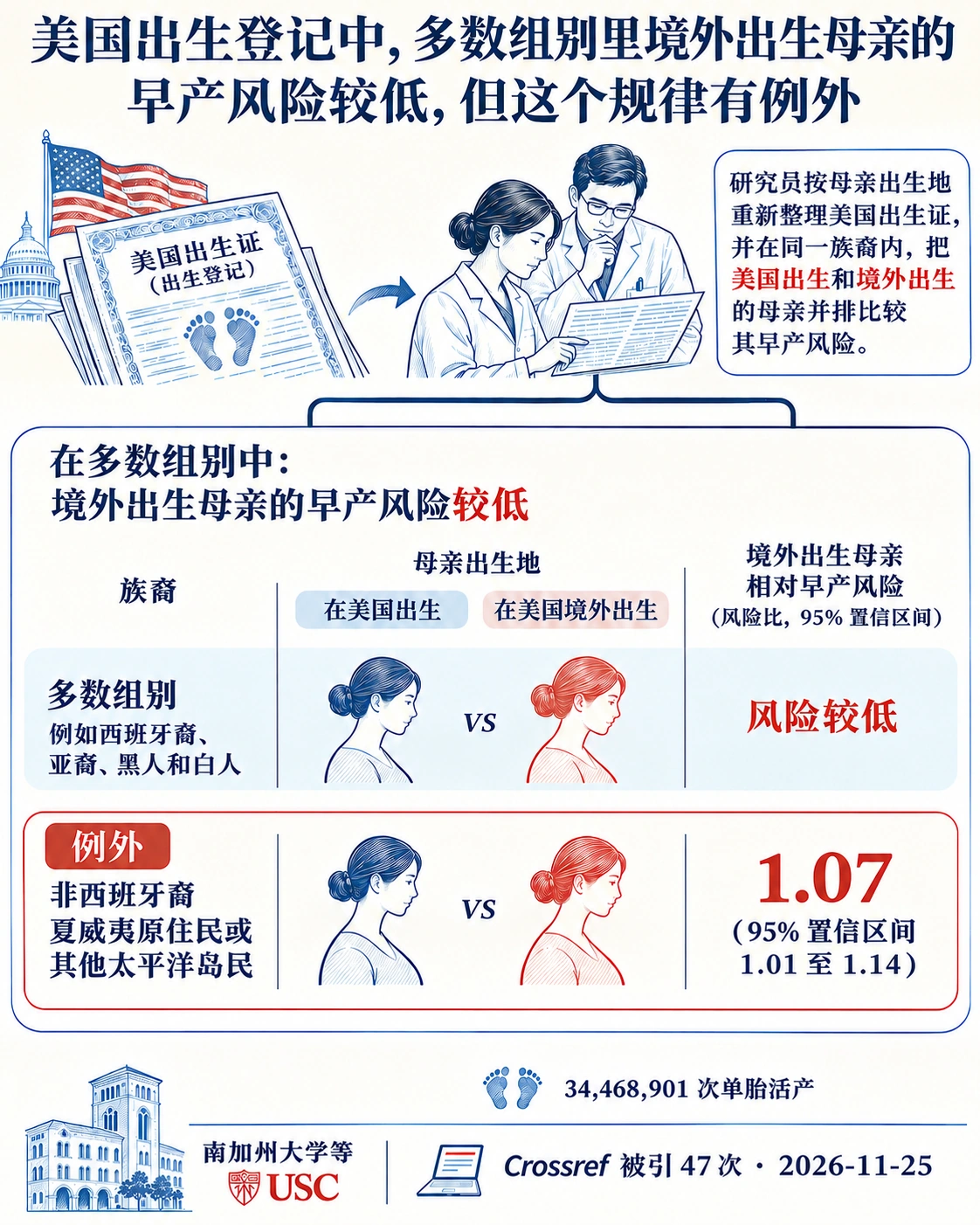
美国逾 3,400 万次单胎活产中,在多个族裔内部,境外出生母亲的早产风险低于美国出生母亲。但在非西班牙裔夏威夷原住民或其他太平洋岛民中,方向相反。
推荐阅读的理由
一个总体平均值可能掩盖人数较少的群体。研究逐组比较美国出生和境外出生的母亲,并按早产发生的孕周重新计算。这样既能看出常见的方向,也能指出哪一群人不能套用总体印象。
Preterm Birth Risk and Maternal Nativity, Ethnicity, and Race
作者摘要 · 中文编译
背景与目的 在美国,移民母亲的早产率通常低于美国出生者,但这一现象在各族裔和不同早产孕周的分布尚缺全国研究。本研究考察母亲出生地、族裔与早产的关系。
设计 作者分析美国 2009 至 2018 年出生证中的住院单胎活产。按母亲是否在美国出生、西班牙裔身份及种族认同划分互斥群体。主要结果为孕 37 周前分娩,另分为 34 至 36 周、29 至 33 周和不足 29 周。研究分别以美国出生非西班牙裔白人作统一参照,以及在各族裔内部比较两种出生地,调整母亲人口与健康因素、出生年份和州。
结果 共 34,468,901 次分娩,母亲平均年龄 28 岁(标准差 6)。以美国出生的非西班牙裔白人为共同参照,除境外出生的白人(调整风险比 0.85,95% 置信区间 0.84 至 0.86)和境外出生的西班牙裔(0.98,0.97 至 0.98)外,其他分组总体早产风险较高。所有少数族裔分组的极早产风险均较高。在多数族裔内部,境外出生母亲的早产风险较低;非西班牙裔夏威夷原住民或其他太平洋岛民是例外,总体、29 至 33 周及 34 至 36 周的风险比依次为 1.07(1.01 至 1.14)、1.10(0.92 至 1.30)、1.11(1.02 至 1.22)。其中 29 至 33 周的区间包含 1。
结论 早产与母亲出生地、族裔的关系随孕周而异。了解这种差异有助于设计有针对性的预防措施,尤其是对以往研究代表性不足的群体。
展开英文原摘要收起英文原摘要Immigrant birthing people have lower rates of preterm birth compared with their US-born counterparts. This advantage and associated racial and ethnic disparities across the gestational age spectrum have not been examined nationally. To examine associations of maternal nativity, ethnicity, and race with preterm birth. This cohort study used birth certificates from the National Vital Statistics System to analyze in-hospital liveborn singleton births in the US between January 1, 2009, and December 31, 2018. Data were analyzed from January to June 2023. Mutually exclusive nativity, ethnicity, and race subgroups were constructed using nativity (defined as US-born or non–US-born), ethnicity (defined as Hispanic or non-Hispanic), and race (defined as American Indian or Alaska Native, Asian, Black, Native Hawaiian or Other Pacific Islander, White, or other [individuals who selected other race or more than 1 race]). The primary outcome of interest was preterm birth. Modified Poisson and multinomial logistic regression models quantified relative risk (RR) of preterm birth overall (<37 weeks’ gestation) and by gestational category (late preterm: 34-36 weeks’ gestation; moderately preterm: 29-33 weeks’ gestation; and extremely preterm: <29 weeks’ gestation) for each maternal nativity, ethnicity, and race subgroup compared with the largest group, US-born non-Hispanic White (hereafter, White) birthing people. The RR of preterm birth overall and by category was also measured within each racial and ethnic group by nativity. Models were adjusted for maternal demographic and medical covariates, birth year, and birth state. A total of 34 468 901 singleton live births of birthing people were analyzed, with a mean (SD) age at delivery of 28 (6) years. All nativity, ethnicity, and race subgroups had an increased adjusted risk of preterm birth compared with US-born White birthing people except for non–US-born White (adjusted RR, 0.85; 95% CI, 0.84-0.86) and Hispanic (adjusted RR, 0.98; 95% CI, 0.97-0.98) birthing people. All racially and ethnically minoritized groups had increased adjusted risks of extremely preterm birth compared with US-born White birthing people. Non–US-born individuals had a decreased risk of preterm birth within each subgroup except non-Hispanic Native Hawaiian or Other Pacific Islander individuals, in which immigrants had significantly increased risk of overall (adjusted RR, 1.07; 95% CI, 1.01-1.14), moderately (adjusted RR, 1.10; 95% CI, 0.92-1.30), and late (adjusted RR, 1.11; 95% CI, 1.02-1.22) preterm birth than their US-born counterparts. Results of this cohort study suggest heterogeneity of preterm birth across maternal nativity, ethnicity, and race and gestational age categories. Understanding these patterns could aid the design of targeted preterm birth interventions and policies, especially for birthing people typically underrepresented in research.
Importance · Immigrant birthing people have lower rates of preterm birth compared with their US-born counterparts. This advantage and associated racial and ethnic disparities across the gestational age spectrum have not been examined nationally.
Objective · To examine associations of maternal nativity, ethnicity, and race with preterm birth.
Design, Setting, and Participants · This cohort study used birth certificates from the National Vital Statistics System to analyze in-hospital liveborn singleton births in the US between January 1, 2009, and December 31, 2018. Data were analyzed from January to June 2023.
Exposure · Mutually exclusive nativity, ethnicity, and race subgroups were constructed using nativity (defined as US-born or non–US-born), ethnicity (defined as Hispanic or non-Hispanic), and race (defined as American Indian or Alaska Native, Asian, Black, Native Hawaiian or Other Pacific Islander, White, or other [individuals who selected other race or more than 1 race]).
Main Outcomes and Measures · The primary outcome of interest was preterm birth. Modified Poisson and multinomial logistic regression models quantified relative risk (RR) of preterm birth overall (<37 weeks’ gestation) and by gestational category (late preterm: 34-36 weeks’ gestation; moderately preterm: 29-33 weeks’ gestation; and extremely preterm: <29 weeks’ gestation) for each maternal nativity, ethnicity, and race subgroup compared with the largest group, US-born non-Hispanic White (hereafter, White) birthing people. The RR of preterm birth overall and by category was also measured within each racial and ethnic group by nativity. Models were adjusted for maternal demographic and medical covariates, birth year, and birth state.
Results · A total of 34 468 901 singleton live births of birthing people were analyzed, with a mean (SD) age at delivery of 28 (6) years. All nativity, ethnicity, and race subgroups had an increased adjusted risk of preterm birth compared with US-born White birthing people except for non–US-born White (adjusted RR, 0.85; 95% CI, 0.84-0.86) and Hispanic (adjusted RR, 0.98; 95% CI, 0.97-0.98) birthing people. All racially and ethnically minoritized groups had increased adjusted risks of extremely preterm birth compared with US-born White birthing people. Non–US-born individuals had a decreased risk of preterm birth within each subgroup except non-Hispanic Native Hawaiian or Other Pacific Islander individuals, in which immigrants had significantly increased risk of overall (adjusted RR, 1.07; 95% CI, 1.01-1.14), moderately (adjusted RR, 1.10; 95% CI, 0.92-1.30), and late (adjusted RR, 1.11; 95% CI, 1.02-1.22) preterm birth than their US-born counterparts.
Conclusions and Relevance · Results of this cohort study suggest heterogeneity of preterm birth across maternal nativity, ethnicity, and race and gestational age categories. Understanding these patterns could aid the design of targeted preterm birth interventions and policies, especially for birthing people typically underrepresented in research.
Alejandra Barreto, Brielle Formanowski, Michelle-Marie Peña, Elizabeth G Salazar, Sara C Handley, Heather H Burris, Robin Ortiz, Scott A Lorch, Diana Montoya-Williams
Copyright 2024 Barreto A et al. JAMA Network Open.
各族裔内部,境外出生对美国出生的总体早产风险
| 母亲族裔 | 调整风险比(95% 置信区间) |
|---|---|
| 西班牙裔 | 0.85(0.85 至 0.86) |
| 非西班牙裔亚裔 | 0.84(0.82 至 0.85) |
| 非西班牙裔黑人 | 0.75(0.74 至 0.76) |
| 非西班牙裔夏威夷原住民或其他太平洋岛民 | 1.07(1.01 至 1.14) |
| 非西班牙裔美洲印第安人或阿拉斯加原住民 | 1.04(0.90 至 1.20) |
每一行都在本组内比较。最后一行区间跨 1,差异不确定。 核对作者图表
作者的结论
作者认为,母亲出生地、族裔及分娩孕周共同影响观察到的早产风险差异。了解具体人群的模式,有助于为在研究中代表性不足的群体设计针对性政策。
研究团队与论文影响
南加州大学等使用美国国家生命统计系统出生证,对 2009 至 2018 年的住院单胎活产进行全国性队列研究。
Crossref 收录本文引用 47 次。JAMA Network Open 在 2025 年度回顾中列出的期刊影响因子为 9.7。
单篇与期刊指标核查于 。
原文与延伸阅读
引用这篇文章与反馈纠错
研象编辑部.美国出生登记中,多数组别里境外出生母亲的早产风险较低,但这个规律有例外[EB/OL].研象,2026-11-25.https://yanxiang.hk/papers/us-nativity-preterm-disparities
发现数字、译文或出处有误,可以在邮件里指出相应段落,附上核对依据。